Sales Coaching
Sales Call Scorecard: Free Template for Founders and AEs
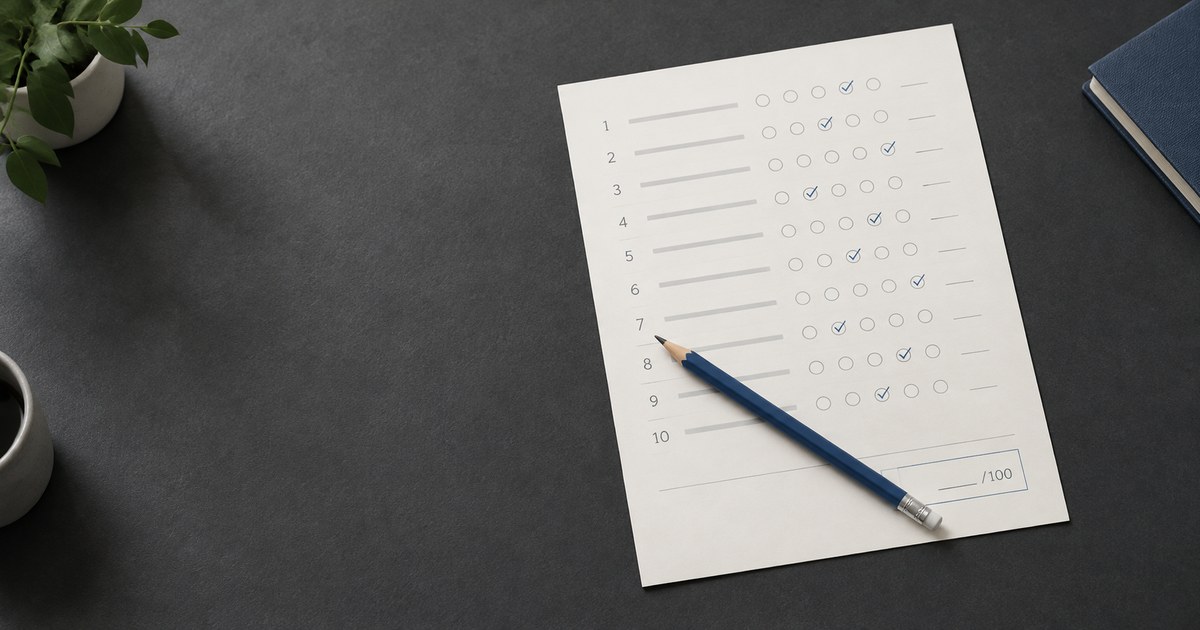
You finish a sales call feeling pretty good.
The prospect was engaged. You answered their questions. They seemed interested in the product.
You even booked another meeting.
But was it actually a good sales call?
Did you understand the problem the buyer was trying to solve?
Did you establish why it mattered?
Did you explore their objections?
Or did you spend most of the conversation talking about your product?
For founders and account executives, one of the hardest parts of improving sales performance is knowing what to evaluate.
A call can feel successful without moving the opportunity forward.
And a call that doesn't produce another meeting can still teach you something valuable about your market or reveal that the prospect isn't a fit.
That's why a sales call scorecard can be useful.
Rather than evaluating conversations based on intuition alone, a scorecard gives you a consistent framework for reviewing what happened and identifying what to improve.
We've created a free 100-point sales call scorecard designed for B2B founders and account executives.
You can use it after discovery calls, product demos, and other meaningful sales conversations.
Here's how it works.
What Is a Sales Call Scorecard?
A sales call scorecard is a structured evaluation tool used to assess specific behaviors and outcomes during a sales conversation.
Rather than asking whether a meeting "went well," a scorecard examines what happened.
For example:
- Did the seller understand the prospect's problem?
- Did they establish the business impact?
- Did they ask useful follow-up questions?
- Did they address relevant objections?
- Did they understand the buying process?
- Did the conversation produce clear next steps?
A scorecard helps turn a subjective impression into a more consistent review.
That doesn't mean every call can be reduced to a number.
A strong call score doesn't guarantee a deal will close.
And a lower-scoring conversation isn't necessarily a failure.
The value comes from identifying behaviors that are worth repeating and skills that need more attention.
Why founders should use a sales call scorecard
When you're conducting founder-led sales, you probably don't have someone regularly reviewing your calls.
You're responsible for generating leads, conducting discovery, demonstrating the product, handling objections, and following up.
It's easy to move from meeting to meeting without spending time reviewing how you're selling.
A simple scorecard gives you a repeatable way to reflect.
You can identify which questions you regularly miss, where you tend to pitch too early, and how well you handle concerns.
You don't need a formal sales enablement program to benefit from that structure.
For a closer look at the product we're building, read about our AI sales coach for founders.
Why account executives should use one
AEs often have access to CRM systems, recorded calls, and manager feedback.
But reviewing the same criteria consistently can still be useful.
It helps you focus on specific improvements rather than generic advice such as "ask better questions" or "handle objections more effectively."
The goal is to develop observable habits.
If you're building a small team, our guide to AI sales coaching for small sales teams explains how individual reps can receive contextual guidance during calls.
Free Sales Call Scorecard Template
Our scorecard evaluates ten areas of a B2B sales conversation.
Each category receives 0, 1, or 2 points, or N/A when it isn't relevant.
The result is normalized to a score out of 100.
You can evaluate the call directly above, copy your results, or print a copy for future reference.
No email required.
The scorecard is intended as a practical coaching aid, not a validated prediction of win probability or sales performance.
The 10 Criteria That Make Up a Useful Sales Call Scorecard
A good scorecard should focus on behavior that matters to the buyer and the purpose of the meeting.
Here's what each of our ten categories is designed to evaluate.
1. Opening and Agenda Alignment
Did the call begin with a clear purpose?
A useful opening doesn't need to be formal.
You might say:
"Based on our last conversation, I thought we'd focus on your onboarding workflow and the implementation concerns you raised. Does that still make sense?"
This creates alignment and gives the prospect an opportunity to adjust the agenda.
A weak opening is one where the seller immediately launches into a presentation without confirming what the buyer needs.
2. Problem Discovery
Did you understand what the prospect is trying to solve?
Not just a general frustration.
A specific problem.
For example:
"Our team is spending every Friday afternoon manually reconciling customer records."
That's much more useful than:
"We need to improve efficiency."
A strong discovery conversation uncovers concrete examples of the problem.
For a deeper framework, read our guide to how to run a B2B discovery call.
3. Business Impact
Did you explore why the problem matters?
A prospect might say their current process is inefficient.
But what does that inefficiency actually affect?
Does it delay customer onboarding?
Create errors?
Consume employee time?
Make it harder to scale?
An important question is:
"What happens when this problem isn't solved?"
You don't need a precise dollar amount on every call.
But you should understand the business consequences well enough to evaluate whether solving the problem is important.
4. Listening and Follow-Up Questions
Did you listen carefully enough to ask useful follow-ups?
This is one of the most important elements of a strong sales conversation.
Imagine the prospect says:
"We've looked at a few alternatives, but none seemed worth switching to."
A seller focused on pitching might immediately explain why their product is different.
A seller focused on discovery might ask:
"What made those alternatives not worth switching to?"
That question could uncover the buyer's actual decision criteria.
Good listening isn't about staying quiet for a particular percentage of the call.
It's about understanding what the buyer says and responding with relevant questions.
5. Buyer Priorities and Success Criteria
Did you learn what the buyer actually cares about?
A product can solve several problems.
But the buyer may only care deeply about one.
Try asking:
"If this worked exactly as you'd hope, what would be different three months from now?"
The answer helps establish what success means to the prospect.
It also gives you something concrete to reference in future conversations.
6. Value Alignment
Did you connect your product to the buyer's needs?
A common demo mistake is showing features without explaining why they're relevant.
For example:
"Our software has a customizable reporting dashboard."
That's a feature statement.
Compare it with:
"You mentioned that your managers spend time compiling updates every week. Here's how the dashboard brings that information into one place."
The second explanation connects the workflow to something the buyer has already described.
If you're preparing a demo, use the same principle: connect each capability to something the buyer has already described.
7. Objection Handling
Did you understand the objection before responding?
A prospect might say:
"That seems expensive."
You could immediately defend your price.
Or offer a discount.
But a more useful first question might be:
"What are you comparing the price against?"
That helps distinguish budget constraints, value concerns, competitive comparisons, and negotiation.
The goal isn't to overcome every objection.
It's to understand whether the issue can be resolved and whether the product is a fit.
Read our guide to handling price objections in sales for additional examples.
8. Buying Process and Stakeholders
Did you understand how the prospect would evaluate and approve a purchase?
In B2B sales, the person using a product isn't always the person authorizing the investment.
The process might involve:
- A department leader
- Finance
- IT
- Security
- Procurement
- Executive leadership
That doesn't mean you need every stakeholder on the first call.
But when relevant, you should understand who needs to participate and what requirements they have.
A useful question is:
"If this looks like a fit, what would your team's evaluation process look like?"
9. Next-Step Clarity
Did the call end with a meaningful next step?
One of the most common signs of a weak sales process is a conversation that ends with:
"Great, let's stay in touch."
That may be perfectly appropriate if there's no reason to continue.
But if the opportunity is progressing, both sides should know what happens next.
For example:
"I'll send the implementation overview by Thursday. You'll review it with your operations lead, and we'll reconnect next Tuesday."
That's a specific commitment.
A good next step should have a purpose, an owner, and an agreed timeframe.
10. Documentation and Follow-Through
Did you capture the information needed for the next conversation?
And did you follow through on what you promised?
A productive call loses much of its value if important details get forgotten.
After the meeting, document:
- The buyer's main problem
- Important objections
- Stakeholders
- Evaluation criteria
- Outstanding questions
- Commitments
- Agreed next steps
Then send an appropriate follow-up.
Our sales call follow-up email templates provide examples for discovery calls, demos, pricing discussions, and other situations.
How to Score a Sales Call Out of 100
The Sideline scorecard uses ten criteria.
Each criterion receives:
- 0 points for a missed behavior
- 1 point for partially demonstrated behavior
- 2 points for strong execution
- N/A if the criterion was genuinely not applicable
If all ten criteria apply, the maximum is 20 raw points.
The result is converted into a score out of 100.
For example:
| Category | Score |
|---|---|
| Opening and Agenda | 2 |
| Problem Discovery | 2 |
| Business Impact | 1 |
| Listening and Follow-Up | 2 |
| Buyer Priorities | 1 |
| Value Alignment | 1 |
| Objection Handling | N/A |
| Buying Process | 1 |
| Next-Step Clarity | 2 |
| Documentation and Follow-Through | 1 |
That produces 13 points across nine applicable categories.
The normalized score is approximately 72/100.
But the number isn't the most important part.
Look at the lowest-scoring categories.
In this example, business impact, value alignment, buyer priorities, buying process, and documentation all deserve additional attention.
A seller might choose to focus on just one of those areas during the next few calls.
For example:
"On my next three discovery calls, I'm going to explore the business impact before explaining our solution."
That's much more actionable than simply trying to improve the overall score.
Should You Use the Same Scorecard for Discovery Calls and Demos?
Not necessarily.
Different meetings have different objectives.
A first discovery call may focus almost entirely on understanding the buyer's situation.
A product demo may emphasize value alignment, objections, and the evaluation process.
A technical review may focus on requirements and implementation concerns.
That's why the scorecard includes an N/A option.
If a criterion is genuinely irrelevant to the purpose of a conversation, exclude it rather than automatically assigning zero.
However, don't use N/A simply because you forgot to address something important.
The important question is:
"Should this have been part of the conversation, given the meeting's purpose and stage?"
If the answer is yes, score the behavior accordingly.
For follow-up calls, reviewing previous context is also important.
Our guide to preparing for a second sales call explains how to bring the right information forward.
Five Common Mistakes When Reviewing Sales Calls
1. Scoring based on whether the prospect was friendly
A pleasant conversation doesn't necessarily mean you ran a strong sales process.
Evaluate what was learned and what happened.
2. Treating a booked follow-up as automatic success
Another meeting can be useful, but only if there's a meaningful reason for it.
The objective isn't to fill the calendar.
3. Trying to improve every category at once
If you score poorly across several areas, choose one skill to focus on first.
Trying to fix everything simultaneously makes improvement harder to assess.
4. Giving yourself high marks without evidence
A score should reflect what actually happened.
If you gave yourself a strong score for discovering business impact, what did the prospect say that supports it?
Where possible, reference your notes or recording.
5. Treating the score as the final outcome
The score is a coaching tool.
It isn't a prediction of whether someone will buy.
A strong seller can run an excellent call and discover that the prospect isn't a fit.
That's still useful selling.
How Often Should You Review Your Sales Calls?
For founders doing their own sales, I'd start by reviewing two or three meaningful calls every week.
You don't necessarily need to score every interaction.
Managers don't need to evaluate every conversation. Here's how to build a sales coaching routine around meaningful call moments and individual improvement.
Focus on calls where you can learn something.
For account executives, the right frequency depends on call volume and the coaching program.
A useful weekly routine could look like this:
Monday: Choose a coaching focus.
During the week: Review two or three relevant conversations.
Friday: Look at the scores and evidence, then identify one behavior to improve.
The value comes from consistency.
If you repeatedly struggle to establish business impact, that pattern is more useful than the score of any single call.
And if you begin improving in that category over subsequent conversations, you'll have some evidence that your habits are changing.
Avoid treating small fluctuations as proof of improvement or decline. Call difficulty and context can vary substantially.
How AI Sales Coaching Can Make Call Reviews More Useful
Traditional sales call scoring takes time.
You need to review a recording, read your notes, identify relevant moments, and decide how the conversation should be evaluated.
AI can help with parts of that process.
For example, an AI tool may help identify:
- Discovery questions that weren't asked
- Objections that were mentioned but never explored
- Buying signals
- Unclear commitments
- Potential follow-up actions
- Patterns that appear across multiple conversations
However, AI-generated feedback still needs to be accurate.
A model can misunderstand the prospect, misattribute a statement, or assume something happened that wasn't actually confirmed.
The goal should be to make coaching easier to apply, not to create another score that nobody trusts.
There's also a timing challenge.
A post-call review can tell you what you missed. But it can't change the conversation that's already over.
That's where real-time AI coaching becomes interesting.
For more background, read our guide to how real-time AI sales coaching works.
How Sideline Is Being Built Around Continuous Sales Coaching
We're building Sideline for founders and B2B sellers who want to improve while they're actually running sales calls.
Sideline is a native macOS AI sales coach.
During conversations, it provides short, contextual prompts intended to help the seller recognize important moments.
Those might include:
- A discovery question worth asking
- A business problem that needs deeper exploration
- An unresolved objection
- A buying signal
- An unclear next step
The goal isn't to overwhelm the seller with another dashboard.
It's to provide a relevant suggestion when it can still be useful.
Coaching after the call
Sideline also provides a post-call debrief.
Rather than simply summarizing the conversation, the debrief focuses on selling behavior.
It helps sellers review missed questions, objections, commitments, and other coaching opportunities.
The product also supports a coaching focus, which can help a seller concentrate on one particular skill.
Coaching across calls
A single conversation doesn't tell the whole story.
We're developing Sideline to help sellers carry important context across multiple meetings and recognize recurring habits.
For example, a founder might consistently fail to ask questions about the buyer's decision-making process.
The objective is to help them recognize that habit, work on it, and evaluate whether their behavior changes.
Sideline maintains prospect and call history, while we're continuing to refine how that history influences future coaching.
You can learn more in our article on AI sales coaching with cross-call memory.
Why we're building it
When I was running founder-led sales, I wanted something that could help during the conversation, not just review what happened afterward.
It's difficult to listen closely, think about the next question, handle objections, and remember everything discussed previously.
We're building Sideline around that challenge.
The product is still evolving through beta development.
We aren't claiming that it perfectly grades every call or that it automatically produces the scorecard on this page.
The interactive scorecard above is a separate, free self-assessment resource.
Our goal is to make useful coaching more accessible to the person actually selling.
A Simple Sales Call Review Checklist
After your next conversation, take five minutes to review:
- Did I establish a clear purpose?
- Did I understand the buyer's actual problem?
- Did I explore its business impact?
- Did I listen and ask meaningful follow-up questions?
- Did I understand what the buyer values?
- Did I connect my solution to their needs?
- Did I clarify important objections?
- Did I understand relevant stakeholders and decision requirements?
- Did we agree on appropriate next steps?
- Did I document and follow through on commitments?
You don't need a perfect score.
You need a clear idea of what you did well and what to improve next time.
Frequently Asked Questions
What is a sales call scorecard?
A sales call scorecard is a structured framework for evaluating how a sales conversation was conducted. It typically examines behaviors such as discovery, listening, objection handling, value alignment, and next-step clarity.
How do you score a sales call?
Choose relevant evaluation criteria, define what strong performance looks like, review the conversation, and assign scores based on evidence. The Sideline template uses ten criteria with values of 0, 1, or 2 and normalizes applicable results to a score out of 100.
What is a good sales call score?
There's no universally accepted score that defines a successful call. Our template uses illustrative ranges to help sellers identify coaching opportunities, but a score should be interpreted in the context of the call's purpose, buyer, and stage.
What should be included in a sales coaching scorecard?
Useful categories include problem discovery, business impact, listening, value alignment, objection handling, buying-process understanding, next steps, and follow-through. The exact categories should reflect your team's sales process.
Can I use a sales call scorecard for discovery calls?
Yes. A discovery call scorecard can help evaluate the quality of questions, depth of understanding, and clarity of next steps. Criteria that are genuinely unrelated to the meeting can be marked N/A.
Should sales managers score every call?
Not necessarily. Reviewing a representative selection of calls may be more practical than evaluating every meeting manually. Focus on consistent criteria, useful feedback, and observable improvement.
Can AI automatically score sales calls?
Some AI sales coaching and conversation intelligence products can analyze transcripts and generate scorecards or recommendations. Their accuracy depends on the system, the call context, and the evaluation criteria. Human review can still be important.
Is this sales call scorecard free?
Yes. The interactive scorecard on this page is free to use. You can enter scores, review your results, copy the summary, and print it without creating an account.
Final Thoughts
The best salespeople aren't necessarily the ones who never make mistakes.
They're the ones who recognize what needs to improve and work on it consistently.
A sales call scorecard gives you a practical place to start.
It helps you move beyond whether a call simply felt good and examine what actually happened.
Did you understand the buyer?
Did you ask useful questions?
Did you explore the objection?
Did you agree on a meaningful next step?
Those are the kinds of behaviors worth reviewing.
Because improving your sales conversations doesn't start with another complicated dashboard.
It starts with knowing what to work on.
Better calls. Better questions. Better selling.
Sideline · Private beta
Better calls start with better questions.
Meet Sideline, the Mac-first AI sales coach designed to help founders and B2B sellers improve with every conversation.
Join the Sideline Beta
How to Run a B2B Discovery Call: A Practical Guide for Founders
A 30-minute agenda, 12 practical questions, and a better way to understand what your buyer really needs.

How to Identify and Handle Sales Objections: A B2B Seller's Playbook
A four-step framework and eight common B2B objections, with follow-up questions that uncover the real concern instead of pushy rebuttals.