Sales Coaching
How to Coach Sales Reps Without Listening to Every Call
You hired your first few sales reps.
Things are moving.
Your team is booking discovery calls, running demos, sending proposals, and building pipeline.
But now you have a new problem.
You want to help your reps get better, and you have almost no time to coach them.
You can't sit in on every call.
You can't spend your evenings listening to recordings.
And you definitely can't review every conversation your team has with a prospect.
So what happens?
Most coaching becomes reactive.
A deal falls apart, and you review what happened.
A rep misses quota, and you discuss their pipeline.
Someone struggles with objections, and you schedule another training session.
The problem is that most of this feedback happens long after the relevant conversation.
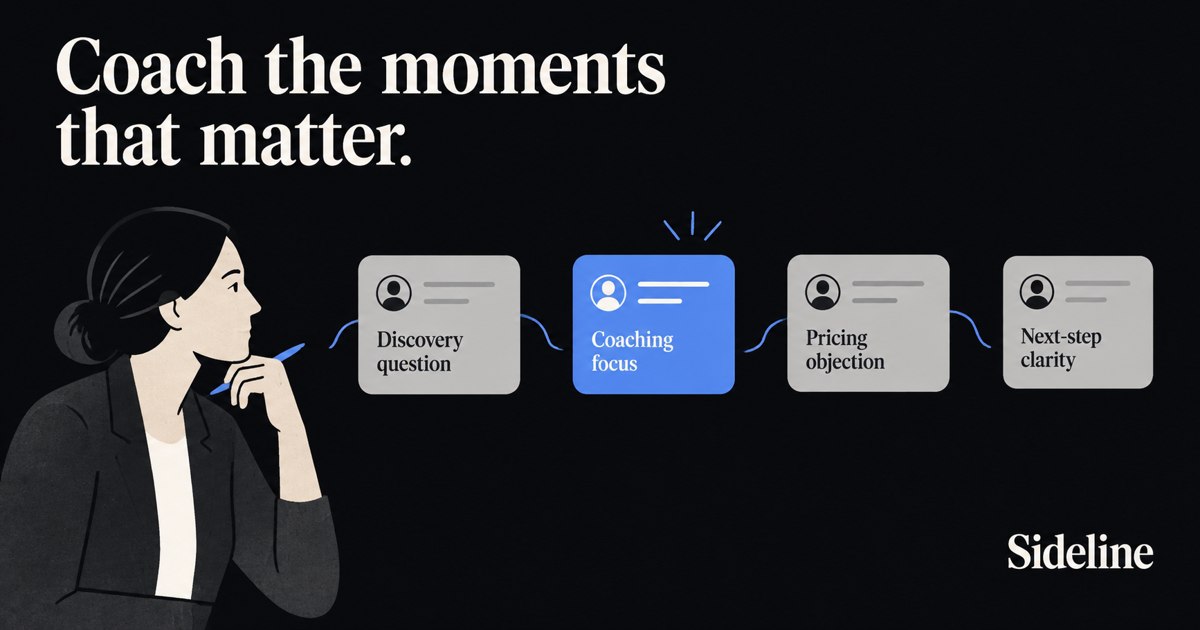
You don't need to listen to every sales call to coach your reps effectively. You need a process for identifying which moments matter and helping your reps improve from them.
That's especially true for founders and small sales teams that don't have dedicated enablement resources.
If you're still running most sales conversations yourself, our AI sales coach for founders page explains how individual coaching can fit into founder-led selling.
Here's how to build a practical coaching system without turning yourself into a full-time call reviewer.
Why Sales Coaching Becomes Difficult as Teams Grow
When you're the founder and the only salesperson, you have direct visibility into every customer conversation.
You know which objections are coming up.
You know which discovery questions work.
You understand the buying process.
And when a deal stalls, you usually have a reasonable idea why.
But once you hire sales reps, that changes.
Your sales conversations are happening without you.
Each rep develops their own habits.
Some ask great discovery questions.
Some pitch too early.
Some handle objections thoughtfully.
Others move straight into explaining features.
You want to understand what's happening, but there's a limit to how much you can personally observe.
The traditional solution: Listen to more calls
Sales managers often try to solve this visibility problem by reviewing recordings.
Call reviews can be incredibly useful.
But if you have several reps conducting multiple conversations each day, reviewing everything isn't practical.
And even if you could listen to every call, that wouldn't automatically make your coaching effective.
More observation doesn't always translate into better development.
The objective isn't to monitor every sentence your reps say.
It's to identify the behaviors that are limiting their effectiveness and help them practice better alternatives.
That requires a more focused approach.
The Difference Between Call Reviewing and Sales Coaching
Call reviewing and coaching are related, but they aren't the same thing.
A call review examines what happened during a conversation.
Sales coaching uses that information to help the seller perform better in the future.
Consider the difference:
| Traditional Call Reviewing | Focused Sales Coaching |
|---|---|
| Reviews an entire conversation | Focuses on relevant moments |
| Identifies multiple mistakes | Prioritizes one improvement |
| Explains what went wrong | Practices what to do differently |
| Often happens after a problem | Builds a repeatable development process |
| May focus on scores | Focuses on observable selling behavior |
| Can become manager-directed criticism | Encourages rep reflection and ownership |
Neither approach needs to replace the other.
Call reviews provide evidence.
Coaching turns that evidence into development.
A useful coaching conversation should answer three questions:
- What happened?
- What could the rep do differently?
- How will we recognize improvement on the next call?
If your feedback never gets past the first question, you're reviewing calls without necessarily coaching anyone.
Step 1: Give Every Rep One Coaching Focus
One of the easiest mistakes sales managers make is trying to improve everything at once.
You listen to a discovery call and notice:
- The opening was unclear.
- The rep pitched too early.
- They didn't quantify the problem.
- They missed a buying signal.
- They handled an objection poorly.
- They failed to establish a next step.
All of those observations might be valid.
But handing a rep six separate areas of improvement after one call can be overwhelming.
Instead, select one behavior to focus on.
Example: A rep who pitches too early
Suppose a newer AE regularly starts demonstrating the product before understanding the prospect's current workflow.
You could give them broad feedback:
"You need to improve your discovery."
But that's not particularly actionable.
A better coaching focus might be:
"Before demonstrating the product, ask the prospect to describe one specific example of the problem they're experiencing."
Now the rep has something concrete to practice.
And you have something observable to evaluate.
What makes a good coaching focus?
A useful coaching focus is:
- Specific
- Observable during a conversation
- Relevant to the rep's current challenges
- Small enough to practice repeatedly
- Connected to better buyer understanding or deal execution
Examples include:
Discovery: Ask one follow-up question about business impact before pitching.
Objections: Clarify what the prospect means before responding.
Stakeholders: Ask how the purchasing decision will be made.
Next steps: Confirm a specific action, owner, and timeframe before ending a meeting.
Demos: Connect each major feature to a problem the buyer described.
The goal isn't to make every salesperson sound identical.
It's to help each rep improve a particular skill.
If discovery is the skill your team needs to work on, start with our B2B discovery call guide.
Step 2: Review Important Moments Instead of Every Minute
You don't need to review every call equally.
Some conversations are more useful for coaching than others.
For example, a routine check-in with an existing customer may offer less insight into discovery skills than a first meeting with a new prospect.
A product demonstration where a buyer raised several objections may provide more useful material for objection-handling practice than a call where everything went smoothly.
The idea is to sample conversations intentionally.
Which calls deserve a closer look?
Consider reviewing conversations where:
A deal stalled unexpectedly.
What did the buyer say? Were important concerns left unresolved?
An objection changed the direction of the call.
Did the rep understand the concern before responding?
A rep struggled with a known development area.
Was there an opportunity to practice the behavior you're coaching?
The rep handled a difficult situation particularly well.
What made the conversation effective, and what can be repeated?
The buying process became more complicated.
Were stakeholders, approval requirements, and next steps clarified?
You don't need to interpret every negative outcome as a selling failure.
Sometimes a deal stalls because the company doesn't have budget, the timing is wrong, or the solution isn't a fit.
Your job is to distinguish the rep's behavior from factors outside their control.
Use targeted sampling
A practical starting point is to review two conversations per rep each week when feasible:
- One where the rep felt they handled the conversation well
- One where they want feedback or encountered difficulty
The rep can identify those calls through their own reflection, notes, or debriefs.
If actual recordings or transcripts are shared, ensure access is authorized and any required recording or data-processing consent has been obtained.
This gives you a more balanced view than only reviewing calls associated with lost deals.
Step 3: Let Reps Evaluate Their Own Calls First
One of the most effective ways to structure a coaching discussion is to ask the rep what they noticed before giving your opinion.
For example:
"What was the most important thing you learned from that conversation?"
Or:
"Was there a moment where you weren't sure what to ask next?"
Or:
"If you could redo one part of the call, what would you change?"
These questions encourage reflection.
They also help you understand whether the rep recognizes the same issue you do.
A sample coaching conversation
Imagine a rep has just finished a product demo.
The prospect raised concerns about implementation effort.
The rep immediately responded by explaining that the platform was easy to deploy.
Here's how a focused coaching conversation might work.
Manager: "How do you think the implementation discussion went?"
Rep: "I think I answered their question pretty well. I explained that setup is straightforward."
Manager: "What did you understand about the specific implementation concern?"
Rep: "Actually, I'm not sure whether they were worried about integrations or how much time their team would need."
Manager: "That's worth exploring. What question could you have asked before explaining the implementation process?"
Rep: "Maybe, 'Which part of implementation would be most difficult for your team?'"
Manager: "Exactly. Let's practice asking that question and following up on their answer."
Notice what happened.
The manager didn't simply say the rep handled the objection poorly.
They helped the rep identify the missing information and formulate a better question.
That's coaching rather than criticism.
Step 4: Use a Consistent Sales Call Scorecard
A scorecard can make reviews more consistent.
Instead of relying entirely on whether a conversation felt good, you can evaluate specific selling behaviors.
Useful categories include:
- Agenda alignment
- Problem discovery
- Business impact
- Listening and follow-up questions
- Buyer priorities
- Value alignment
- Objection handling
- Stakeholder understanding
- Next-step clarity
- Documentation and follow-through
However, scoring every category on every call isn't always appropriate.
A discovery call has different objectives from a technical evaluation.
And a prospect's behavior can affect which opportunities arise.
The score should reflect the purpose of the meeting.
Try our free 100-point sales call scorecard
We've created a free interactive tool that helps founders, AEs, and managers review sales conversations.
You can evaluate ten areas, mark criteria that weren't applicable, and identify the lowest-scoring areas.
It also includes a copyable template and a print-friendly format.
No email or account is required to use the tool.
Don't confuse scores with coaching
A scorecard can help identify areas to investigate.
It doesn't automatically explain why a rep behaved a certain way.
For example, a low score on next-step clarity may mean the rep forgot to ask.
But it could also mean the buyer wasn't ready to commit to a next meeting.
The coaching conversation should investigate what happened before deciding what to change.
And a score of 90 doesn't automatically mean a deal will close.
Use scores as a starting point, not as a substitute for judgment.
Step 5: Build a 25-Minute Weekly Coaching Routine
You don't need an elaborate sales enablement program to coach a small team.
You need a repeatable rhythm.
For a team of two to ten sellers, a short individual coaching session can be a practical starting point.
Here's one framework.
The 25-Minute Sales Coaching Meeting
| Time | Activity | Purpose |
|---|---|---|
| 3 minutes | Rep reflection | Understand how the rep feels they're progressing |
| 7 minutes | Review one important moment | Identify what happened and why |
| 7 minutes | Practice an alternative | Roleplay a better question or response |
| 5 minutes | Choose one coaching focus | Create a concrete improvement goal |
| 3 minutes | Agree on follow-through | Decide how the rep will practice and reflect |
This is an illustrative agenda, not a universal best practice.
Adjust the timing based on the rep's experience and the complexity of the situation.
Make the meeting about development
Try not to turn the coaching session into another pipeline meeting.
Pipeline reviews answer questions such as:
"Which opportunities are likely to close?"
Coaching sessions answer questions such as:
"What can we do to help this seller conduct better conversations?"
Both are useful.
But they should serve different purposes.
Example weekly coaching routine
Monday
The rep chooses a specific skill to work on.
Tuesday–Thursday
The rep practices that skill during relevant sales calls and notes useful moments.
Friday
The rep and manager review one example, discuss what happened, and practice an alternative if needed.
Following Monday
The rep decides whether to continue the focus or move to another behavior.
You can repeat this process without creating a complicated scorekeeping system.
Over time, those small improvements can become part of how your team sells.
Step 6: Coach the Behavior, Not Just the Outcome
It's easy to assume that a closed-won deal reflects good selling and a lost deal reflects poor selling.
But outcomes alone don't tell the whole story.
A rep can conduct a thoughtful discovery call and learn that the prospect genuinely isn't a fit.
Another rep can close a deal despite skipping important qualification questions.
If you only evaluate outcomes, you may reinforce the wrong behaviors.
Separate controllable actions from results
For example:
Outcome: The prospect didn't book a follow-up meeting.
Behavior to review: Did the rep understand what information the buyer needed to make a decision?
Or:
Outcome: The prospect objected to pricing.
Behavior to review: Did the rep clarify whether the issue was budget, value, or comparison with another solution?
Or:
Outcome: The buyer requested a technical evaluation.
Behavior to review: Did the rep establish the requirements, stakeholders, and next steps?
The goal isn't to ignore revenue outcomes.
It's to identify the selling behaviors that are worth developing.
That's how coaching becomes more useful than simply telling a rep to close more deals.
For additional examples, read our guide to how to identify and handle sales objections.
Step 7: Give Reps Coaching Between Manager Sessions
Even a great weekly coaching meeting has a limitation.
Most selling happens between those meetings.
A rep might discuss objection handling on Monday, then encounter three difficult objections before the next coaching session.
They need to remember what they practiced while conducting live conversations.
That's not always easy.
They're listening to the prospect.
Thinking about their product.
Trying to handle unexpected questions.
And managing the direction of the call.
This creates an opportunity for tools that help sellers reflect and receive relevant guidance between formal reviews.
Post-call feedback
A useful post-call debrief can help a rep identify:
- Missed discovery questions
- Unresolved objections
- Unclear next steps
- Important commitments
- Areas for improvement
It gives the seller something concrete to review while the conversation is still fresh.
Context across conversations
If a prospect raised an important concern during the first meeting, that information should remain relevant during the second.
Useful cross-call context can help the seller avoid repeatedly rediscovering the same information.
For more on this, read our guide to AI sales coaching with memory.
Live coaching
The most interesting possibility is recognizing important moments while a conversation is still happening.
For example:
Prospect: "We're interested, but I think our CFO would need to sign off."
Illustrative coaching prompt: "Ask what the CFO needs to approve."
That's a question the seller can consider asking immediately.
They don't need to wait for their manager to notice the missed opportunity in a recording later.
The suggestion may not always be necessary or correct, and the seller remains responsible for deciding what fits the conversation.
But when relevant, a short prompt can make coaching useful at the moment of action.
For a deeper explanation of how contextual prompts work, read our guide to real-time AI sales coaching.
How Sideline Helps Individual Reps Improve
We're building Sideline around a simple idea:
Sales coaching should be useful while you're selling, not just after the call is over.
Sideline is a native macOS AI sales coach designed for B2B founders and account executives.
During live conversations, Sideline provides short, contextual coaching prompts through a desktop overlay.
Those suggestions are designed to help sellers recognize opportunities involving:
- Discovery
- Business impact
- Objections
- Buying signals
- Stakeholder questions
- Next steps
The goal isn't to provide a long script or tell the seller exactly what to say.
It's to surface one useful question or action when it may help move the conversation forward.
Coaching after the call
Sideline also provides post-call debriefs focused on selling performance.
These can help individual sellers review missed opportunities and identify areas they want to work on.
The product maintains prospect and call history, and we're continuing to refine how that context informs future coaching.
Improving across multiple conversations
Many selling habits are recurring.
A rep might repeatedly pitch too early.
Another might struggle to explore pricing concerns.
Another may conduct strong discovery but end conversations without clear next steps.
Sideline's coaching focus and cross-call development are designed around recognizing and improving those individual patterns over time.
These capabilities are continuing to evolve during private beta.
Designed for the individual seller
Sideline is not a manager surveillance platform.
It doesn't currently provide a manager dashboard, team-wide leaderboard, or automatic access to a rep's private coaching history.
That distinction matters.
The seller should be able to develop their skills using feedback designed to help them, not simply generate another management report.
Founders and sales leaders can encourage individual reps to use coaching tools and voluntarily bring relevant learning into one-on-one meetings.
But that isn't the same as automatically monitoring every conversation.
We're building a coach for the person doing the selling.
If you're building a growing team, read more about AI sales coaching for small sales teams.
A Sales Manager's Coaching Checklist
Use this checklist to build a lightweight coaching process.
Before a coaching session
During the session
After the session
You don't need to complete every item during every coaching meeting.
The purpose is to make feedback specific, practical, and consistent.
Common Sales Coaching Mistakes to Avoid
1. Trying to fix everything at once
Give a rep one clear development priority rather than an overwhelming list of corrections.
2. Only reviewing lost deals
Good conversations are worth studying too.
A strong example can demonstrate behaviors worth repeating.
3. Confusing pipeline reviews with coaching
Discussing deal status is not the same as helping a seller develop new skills.
Make time for both.
4. Making coaching feel like surveillance
Reps are less likely to reflect openly if every conversation feels like an opportunity for punishment.
Be transparent about how recordings, notes, and evaluations are used.
Respect privacy and applicable consent requirements.
5. Giving feedback without practice
Knowing what went wrong isn't the same as knowing what to do next time.
Roleplay the alternative.
6. Measuring improvement only through closed deals
Revenue matters.
But learning whether someone asks better questions or handles objections more effectively requires examining behavior as well.
7. Forgetting to follow up on the coaching focus
If every coaching session introduces a new priority, reps may never spend enough time improving the previous one.
Revisit the skill and evaluate progress.
Frequently Asked Questions
How do you coach sales reps effectively?
Choose specific selling behaviors to improve, review relevant examples, encourage rep self-assessment, practice alternative responses, and follow up on progress. Consistency matters more than reviewing every conversation.
How often should sales managers coach their reps?
The appropriate frequency depends on team size, rep experience, and sales complexity. A focused weekly one-on-one can be a useful starting point for small teams, supplemented by more frequent feedback when needed.
Do sales managers need to listen to every call?
No. Reviewing selected conversations can provide useful coaching evidence without requiring managers to monitor every call. The key is choosing representative moments and avoiding conclusions based on one isolated example.
How do you coach underperforming sales reps?
Start by understanding the causes of the performance gap. Review observable selling behaviors, distinguish skill problems from pipeline or market issues, identify one improvement area, and develop a plan for practicing and evaluating that behavior.
What should be included in a sales coaching session?
A useful coaching session may include rep reflection, review of an important conversation moment, discussion of alternatives, roleplay, and agreement on a specific development goal.
Can AI help coach sales reps?
AI tools can assist with call summaries, identifying possible coaching opportunities, preparing context, and providing feedback. Some products also offer guidance during live conversations. The usefulness and accuracy of these features depend on the system and the situation.
What's the difference between sales coaching and sales call monitoring?
Monitoring focuses on observing or evaluating conversations. Coaching focuses on helping sellers improve their skills and behavior. Monitoring can provide evidence for coaching, but it doesn't automatically produce development.
What is a sales call scorecard?
A sales call scorecard is a structured framework for evaluating a conversation against relevant criteria. Sideline offers a free interactive 100-point scorecard that founders, reps, and managers can use for self-assessment.
Does Sideline allow managers to monitor their entire sales team?
Sideline is currently focused on private, individual sales coaching rather than manager surveillance. It does not provide a centralized manager monitoring dashboard or team-wide leaderboard.
Is Sideline suitable for small B2B sales teams?
Sideline is being developed for individual B2B sellers, including reps working in small teams. It is currently in private beta and is Mac-first. Teams interested in participating can apply for early access.
Final Thoughts
You don't need to listen to every sales call to help your team improve.
You need to understand the behaviors that matter.
Choose the right conversations to review.
Help reps recognize what happened.
Practice what they could do differently.
And give them the tools and support to improve between coaching sessions.
Because great sales coaching isn't about finding every mistake.
It's about helping someone become a better seller, one conversation at a time.
That's the kind of coaching we're building Sideline to support.
Better questions. Better conversations. Better selling.
Sideline · Private beta
Better sales coaching starts with better conversations.
Meet Sideline, the Mac-first AI sales coach built to help B2B sellers ask better questions and improve from every call.
Join the Sideline Beta
Sales Call Scorecard: Free Template for Founders and AEs
Evaluate discovery, objection handling, buying signals, and next steps with a free interactive 100-point sales call scorecard.

How to Identify and Handle Sales Objections: A B2B Seller's Playbook
A four-step framework and eight common B2B objections, with follow-up questions that uncover the real concern instead of pushy rebuttals.

Real-Time AI Sales Coaching: How It Works and Why It Matters
How live AI coaching works during a sales call, how it compares to post-call analysis, and where it helps founders and reps most.