AI Sales Coaching
How AI Sales Coaching Remembers Previous Conversations (And Why It Matters)
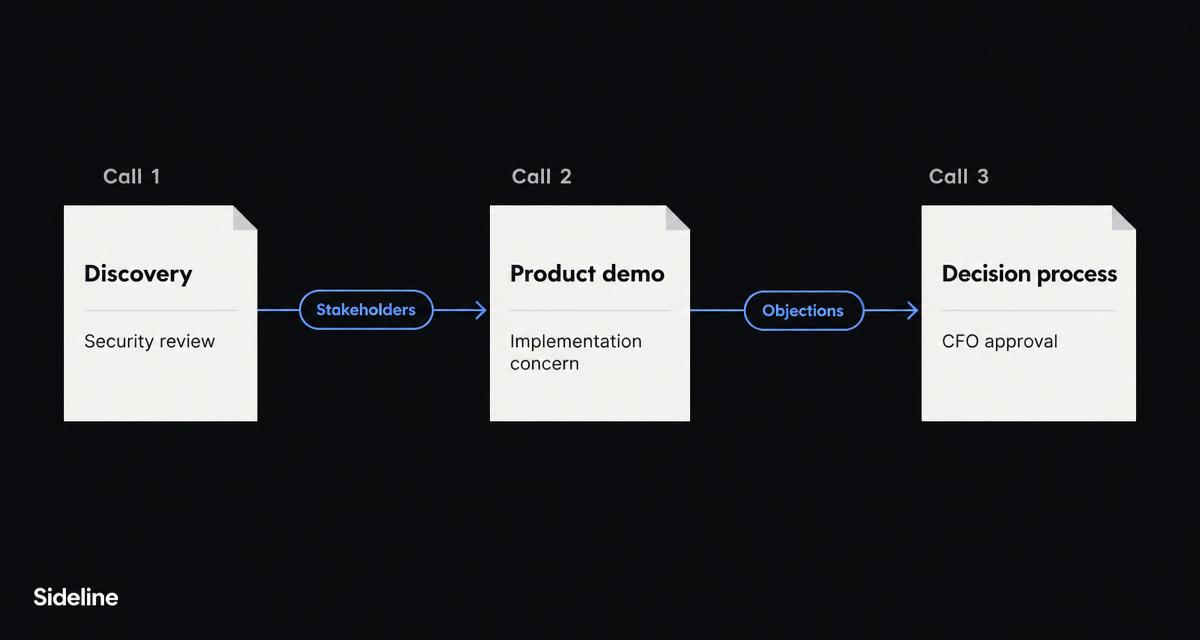
You're on your third call with a potential customer.
The first conversation went well. You learned about their biggest challenges, discussed their existing process, and identified a few areas where your product could help.
During the second call, you gave a demo. The prospect raised concerns about implementation, mentioned that their CFO would need to approve the purchase, and asked you to send additional information.
Now you're speaking again.
But you're juggling twelve other opportunities, several demos, and a growing list of follow-ups.
You remember the prospect.
You remember they liked the product.
But the specific details?
Not all of them.
So you start the conversation without revisiting the implementation objection. You explain pricing without addressing the CFO's requirements. And you forget to follow up on something you promised two weeks earlier.
The meeting might still go reasonably well.
But you've missed opportunities to move the conversation forward.
This is the problem cross-call memory in AI sales coaching is designed to solve.
Instead of treating every meeting as an isolated conversation, an AI sales coach can use relevant information from previous calls to provide more contextual guidance.
That changes what AI coaching can potentially do.
It's no longer just about understanding what's being said right now.
It's about understanding what happened before, what still matters, and what the salesperson should consider next.
What Is Cross-Call Memory in AI Sales Coaching?
Cross-call memory is the ability of a sales coaching system to retain and use relevant information across multiple conversations.
Traditional meeting tools often focus on the individual meeting.
They record a call, generate a transcript, create a summary, and identify action items.
Those functions are useful.
But they don't necessarily mean the information will influence the next sales conversation.
A system with cross-call memory can maintain context such as:
- Problems the prospect previously described
- Business impact and priorities
- Objections raised in earlier meetings
- Decision-makers and other stakeholders
- Unanswered discovery questions
- Commitments made by either party
- Evaluation criteria and timelines
- Changes in the opportunity over time
The objective isn't to remember every word.
It's to remember the information that could change what happens next.
For example, if a prospect mentioned that security approval was required during the first meeting, that detail may still matter during the third.
If the salesperson promised to send integration documentation, that commitment shouldn't disappear just because a new meeting has started.
And if the prospect's priorities change, the system should reflect the newer information rather than continuing to rely on an outdated summary.
That's what makes useful cross-call memory different from simply storing transcripts.
Good cross-call memory starts with useful discovery. Our guide to how to run a B2B discovery call explains the questions worth asking in that first conversation.
Why Individual Call Summaries Aren't Enough
Imagine a typical B2B deal involving three conversations.
Call 1: Discovery
The prospect explains that their current onboarding process takes too long.
You learn that:
- The process involves manual work across several teams.
- The operations director wants to reduce delays.
- A security review will be required before adopting another product.
- The company hopes to implement a solution next quarter.
The call ends.
Your meeting tool produces a summary.
Useful.
Call 2: Product Demo
Two weeks later, you demonstrate your solution.
The prospect likes the product but raises two new concerns.
First, implementation may require more internal resources than expected.
Second, the CFO will need to approve the budget.
You agree to send an implementation overview.
Another summary gets created.
Also useful.
Call 3: Commercial Discussion
Now you're discussing pricing and next steps.
The prospect asks whether you can begin implementation within six weeks.
You explain the process and available options.
But you forget that implementation effort was their primary concern during the previous meeting.
And you haven't confirmed whether the CFO has reviewed the proposal.
The third call might look productive in isolation.
But when you examine the entire history, you can see two unresolved issues that may determine whether the deal proceeds.
The value of cross-call memory is connecting those conversations into one evolving picture of the opportunity.
A better coaching experience would help the seller recognize what remains unresolved, what has changed, and what deserves attention.
Single-Call Analysis vs. Cross-Call Coaching
These approaches are related, but they are not interchangeable.
| Capability | Single-Call Analysis | Cross-Call Coaching |
|---|---|---|
| Summarizes the current conversation | Yes | Yes, depending on the tool |
| Identifies objections raised on a call | Yes | Yes |
| Remembers objections from earlier meetings | Not necessarily | Designed to |
| Tracks open commitments across meetings | Not necessarily | Designed to |
| Uses previous discovery gaps | Usually limited to the current call | Can carry them forward |
| Recognizes changes in buyer priorities | Requires comparing records | Can connect new and previous context |
| Supports longer-term seller development | Depends on the product | Can use patterns across calls |
| Helps prepare for a follow-up meeting | Through notes and summaries | Through structured prior context |
These are differences in system capabilities, not claims that all products in either category work identically.
Some conversation intelligence platforms already support multiple forms of persistent context.
The distinction worth evaluating is not whether a tool stores information.
It's whether the relevant information actually helps you during future conversations.
For a look at how focused live coaching differs from broader revenue intelligence, read our Sideline vs. Gong comparison.
How Cross-Call AI Sales Coaching Works
The general approach involves three connected stages.
1. Before the Call: Bring Forward What Matters
Before a meeting begins, a context-aware AI sales coach can assemble a briefing from previous conversations.
That briefing might include:
Prospect: Sarah, VP of Operations
Company: Northwind Health
Meeting: Third conversation
Previously discussed:
- Manual onboarding is delaying team productivity.
- Security approval is required.
- CFO approval is needed for the purchase.
- Implementation effort is a concern.
Open commitment:
- Send implementation overview.
Unanswered question:
- What would the CFO need to approve the purchase?
This provides something more useful than a generic company profile.
It's a summary of the context that may shape the next conversation.
The salesperson can review it quickly and prepare questions around the most important unresolved issues.
For more practical advice on this process, read our guide to how to prepare for a second sales call.
2. During the Call: Use Previous Context at the Right Moment
This is where cross-call memory becomes especially interesting.
It's one thing to display previous notes before the meeting.
It's another to recognize when those notes become relevant during a new conversation.
Imagine the prospect says:
"We could probably start implementing next month."
A coach that only understands the current call might suggest:
"Ask about the implementation timeline."
That's a reasonable question.
But a coach with relevant previous context may know that the prospect was concerned about implementation resources during the last meeting.
A more contextual suggestion could be:
"Last call, implementation resources were a concern. Ask what changed."
That's a more specific question.
It connects the current conversation to something the buyer previously identified as important.
Recognizing buying signals in sales can also help sellers understand when a prospect is moving from general interest toward a real evaluation.
Another example:
Previous call: The prospect said their CFO needed to approve the purchase.
Current call: "I think we're getting close to making a decision."
Illustrative coaching prompt: "Ask whether finance has reviewed the proposal."
The purpose isn't to force the seller to follow every AI suggestion.
It's to make important context available while the salesperson can still act on it.
A good live coaching system should also recognize when not to interrupt.
If a question has already been answered, repeating it provides little value.
If a previous concern has been resolved, continuing to raise it may distract the conversation.
And if the buyer changes their position, newer information should take precedence over older assumptions.
For a broader explanation of how live suggestions work, read Real-Time AI Sales Coaching: How It Works and Why It Matters.
3. After the Call: Update the Context
After the meeting, new information becomes available.
Perhaps the buyer confirms that the CFO has approved the budget.
Perhaps implementation is no longer a concern.
Or perhaps the timeline moves from November to January.
The system should be able to update its understanding.
For example:
Previous status:
- CFO approval: Unknown
- Implementation concern: Open
- Timeline: Next quarter
New status after the call:
- CFO approval: Confirmed by prospect
- Implementation concern: Still open
- Timeline: January
The distinction between facts, assumptions, and unconfirmed commitments matters.
An AI coach shouldn't mark a commitment as completed simply because the salesperson says it probably happened.
Nor should it treat a tentative timeline as a confirmed purchasing decision.
Reliable context requires accuracy and an ability to recognize uncertainty.
Without that, memory can make coaching worse rather than better.
Why Cross-Call Memory Matters for Founder-Led Sales
For early-stage founders, sales is rarely the only responsibility.
You're building the product.
Talking to customers.
Managing your team.
Handling support.
Trying to generate revenue.
And conducting your own sales calls.
You might have five active opportunities one week and fifteen the next.
Each prospect has different concerns, priorities, and next steps.
Remembering every detail becomes increasingly difficult.
A good CRM helps organize the information.
But it still requires the founder to review the right records and apply them during the conversation.
This is why AI sales coaching with memory can be particularly relevant to founder-led sales.
Instead of only producing another record, a coach can potentially bring previous context into the live conversation.
It might remind you that:
- You never established the financial impact of the problem.
- The prospect mentioned an existing vendor contract.
- A stakeholder was supposed to attend the next meeting.
- You promised to provide an answer to a technical question.
- The buyer's timeline has changed since the first call.
Those reminders don't automatically close deals.
But they can make it easier to run a focused, informed conversation.
And when you're a founder without a dedicated sales manager, that additional context may be particularly useful.
Remembering the Prospect Is Only Half the Opportunity
Most discussions about AI memory focus on the customer.
What did the prospect say?
What objections did they raise?
Who needs to approve the purchase?
Those are important questions.
But there's another category of information worth carrying forward.
How is the salesperson performing across calls?
Imagine a founder who conducts fifteen sales meetings.
Across those conversations, they repeatedly:
- Start pitching before understanding the problem
- Avoid asking about budget
- Fail to explore implementation concerns
- Leave meetings without clear next steps
A single-call analysis might identify these problems individually.
But without connecting the observations, the salesperson may never recognize the broader habit.
An AI coach that tracks seller patterns can potentially recognize recurring weaknesses.
For example:
"You've repeatedly moved into product demos before establishing business impact."
That insight can become a specific coaching objective.
During subsequent calls, the coaching system can place more emphasis on recognizing opportunities to explore business impact.
Afterward, it can review whether the seller demonstrated that skill.
This is different from merely generating a score after every meeting.
The goal is to create continuity in how the salesperson develops.
How Sideline Is Building Cross-Call Coaching
We're building Sideline around a simple idea:
Your sales coach shouldn't forget everything when the meeting ends.
Sideline is a native macOS AI sales coach for founders and individual B2B sellers.
During sales conversations, it provides short, contextual coaching prompts.
Those prompts are designed to help sellers recognize missed questions, objections, buying signals, and opportunities to move the conversation forward.
After the call, Sideline provides a debrief focused on selling performance rather than just meeting notes.
It also maintains prospect and call history.
We're actively refining how that history informs future coaching.
Prospect memory
Sideline's approach to prospect memory focuses on the information that matters between conversations.
That includes prior objections, discovery gaps, stakeholder context, and commitments.
The goal is to help the seller continue the conversation rather than restart discovery every time.
Coaching focus
Sideline also supports a specific coaching focus for the seller.
For example, you might be working on asking better questions about business impact.
The debrief can evaluate whether that behavior appeared during a conversation.
Across calls, the product is designed to help surface recurring coaching patterns.
Live coaching
The most important part is making previous context useful during the call.
We want Sideline to recognize the difference between a prospect raising a new objection and revisiting something discussed two meetings ago.
The coaching should be short, relevant, and easy to act on.
Not a lengthy paragraph.
Not a transcript dump.
Just a useful next question when there's an opportunity to ask it.
Still in private beta
Sideline's cross-call intelligence, coaching quality, and reliability are still being refined.
Not every planned memory or coaching behavior should be treated as fully available or perfect.
We're developing these capabilities with the goal of making the product more valuable as sellers use it across more conversations.
Our vision is a coach that understands both the prospect you're selling to and the habits you're trying to improve.
What to Look for in AI Sales Coaching With Memory
If you're evaluating an AI sales coaching tool, don't stop at asking whether it remembers previous calls.
Ask how that memory actually works.
1. Does it remember useful information or just store transcripts?
A transcript archive is helpful.
But can the system identify the important context?
Can it distinguish a real buyer objection from a passing comment?
Can it identify unresolved questions?
2. Can it recognize when information changes?
A prospect's priorities can evolve over several meetings.
Good context management should account for newer information and avoid repeating outdated assumptions.
3. Does it track commitments accurately?
A salesperson might promise to send security documentation.
The prospect might agree to discuss the proposal with finance.
Both matter.
But the system should distinguish a commitment being made from that commitment being completed.
4. Does previous context influence live coaching?
This is a particularly important distinction.
A tool might generate excellent pre-call briefings but never use that information while the conversation is happening.
If you want coaching during live calls, test whether previous context informs those suggestions.
5. Does it help the seller improve over time?
Remembering the prospect is useful.
Recognizing repeated selling habits can be equally valuable.
Look for tools that connect feedback across calls rather than treating every debrief as a separate event.
6. Can you review and correct the information?
AI-generated summaries and interpretations can be wrong.
A trustworthy system should make it possible to distinguish verified facts from inferred conclusions.
Before relying on a claim about budget, approvals, or commitments, sellers should be able to check the supporting conversation evidence.
7. Does it fit your privacy and security requirements?
Sales conversations can contain confidential business information.
Evaluate what is stored, how long it is retained, who can access it, and what consent or recording disclosures are required.
Different tools handle these requirements differently.
For an overview of available categories and features, read our comparison of the best AI sales coaching tools in 2026.
Different AI sales assistants approach conversation history differently. Our Sideline vs. Convo comparison explores two approaches to live sales coaching and persistent prospect context.
A Practical Cross-Call Memory Checklist
Even without specialized software, you can start improving how you preserve context between sales meetings.
After each call, capture:
- The prospect's main business problem
- The impact of that problem
- The buyer's current process or alternative
- Objections that remain unresolved
- Known stakeholders and decision requirements
- Important deadlines and evaluation criteria
- What you committed to do
- What the prospect committed to do
- Questions you still need to ask
- Changes since previous conversations
- One thing you personally want to improve next time
Before the next meeting, review those details and identify which ones are most relevant.
Don't turn the call into a rigid checklist.
Use the information to ask better questions.
And when the meeting ends, update the record.
If you're preparing your next email, our sales call follow-up email templates can help you summarize the conversation and clarify commitments.
Frequently Asked Questions
What is AI sales coaching with memory?
AI sales coaching with memory refers to systems that retain relevant information from previous conversations and use it to support future coaching. This can include prospect history, unresolved objections, commitments, and seller performance patterns.
Can AI remember previous sales calls?
Yes. Systems designed with persistent memory can retain information across conversations. However, capabilities vary significantly by product. Some store transcripts and summaries, while others use structured context to inform future analysis or live coaching.
How is cross-call memory different from CRM notes?
CRM notes primarily store information for later reference. Cross-call AI coaching aims to use that information to provide relevant guidance during future conversations. The two approaches can complement each other.
Can AI track objections across multiple sales calls?
Some systems can retain objections identified in earlier conversations and reference them later. Accuracy depends on how objections are extracted, stored, updated, and connected to the correct prospect.
Can AI sales coaching improve over time?
It can become more context-aware when designed to use prior conversations and seller patterns. That doesn't necessarily mean the underlying AI model is retrained on every call. It may instead use saved information to provide more relevant suggestions.
Does cross-call memory replace a CRM?
Not necessarily. A CRM manages contacts, opportunities, activities, and sales processes. Cross-call memory focuses on retaining and applying conversation context. Depending on the product, the two may operate separately or integrate.
Is cross-call memory available in Sideline?
Sideline includes prospect and call history and is actively developing cross-call coaching that uses prior objections, discovery gaps, and commitments. The product is in private beta, and these capabilities continue to be refined.
Final Thoughts
A good sales conversation doesn't exist in isolation.
It's part of a relationship.
The first call helps you understand the problem.
The second helps you explore a solution.
The third might involve implementation, pricing, or internal approval.
Each conversation should build on what happened before.
That's the promise of AI sales coaching with memory.
Not simply recording everything.
Not generating another summary.
But helping you remember what matters, recognize what's changed, and ask better questions while the prospect is still there.
Because your next sales call shouldn't start from scratch.
And neither should your sales coach.
Better calls. Better context. Better selling.
Sideline · Private beta
Your next call shouldn't start from scratch.
Meet Sideline, the Mac-first AI sales coach built for founders and B2B sellers. Get coaching during your conversations and context that carries forward.
Get Early Access
How to Prepare for a Second Sales Call: 7 Steps to Keep B2B Deals Moving
A seven-step preparation checklist, 30-minute agenda, practical questions, and a reusable pre-call brief for your next B2B conversation.

Real-Time AI Sales Coaching: How It Works and Why It Matters
How live AI coaching works during a sales call, how it compares to post-call analysis, and where it helps founders and reps most.

Best AI Sales Coaching Tools in 2026: 8 Options Compared for Founders & Sales Teams
Eight AI sales coaching tools compared — live coaching, call reviews, and practice — with a focus on founders, AEs, and growing B2B teams.