Founder-Led Sales
15 Sales Questions That Reveal Buying Intent (Not Just Interest)
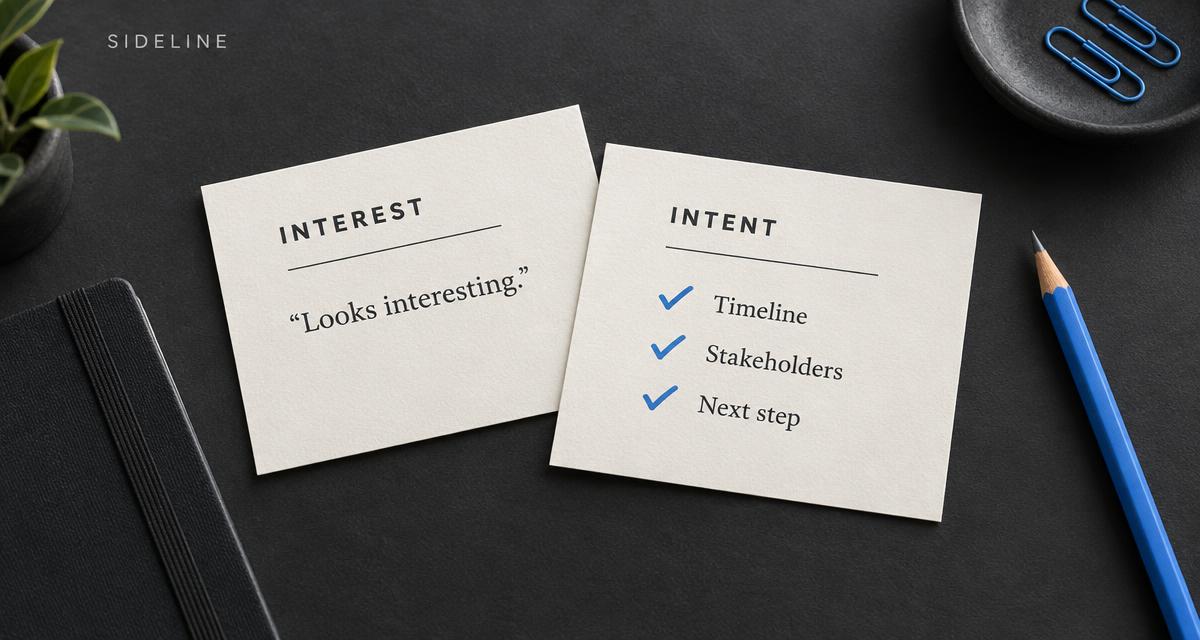
The prospect loved your demo.
They asked thoughtful questions. They complimented your product. They even said, "This looks really interesting."
You hang up feeling like the deal is moving.
Two weeks later, they haven't replied to your follow-up.
Sound familiar?
One of the harder lessons in B2B sales is that interest and buying intent are not the same thing.
A prospect can genuinely like your product without having the urgency, authority, budget, or organizational support to buy it.
They might be researching the market. They might be curious about new technology. They might even be gathering information for a project that won't happen for another year.
That's why good sales discovery goes beyond finding out whether someone has a problem.
You need to understand whether they're prepared to do something about it.
Here are 15 questions that can help you distinguish serious buying intent from polite interest, along with examples of what to listen for.
What Are Buying Signals in B2B Sales?
Buying signals are actions, statements, or behaviors that suggest a prospect may be moving toward a purchase decision.
Some signals happen outside a meeting.
A prospect might request a proposal, introduce additional stakeholders, or begin a formal evaluation.
Others appear during a sales conversation.
For example:
- "What would implementation look like for our team?"
- "Can we include our operations director in the next meeting?"
- "How does your pricing change if we expand to 50 users?"
- "We need something in place before our next hiring cycle."
These are worth exploring.
But none proves that the prospect will buy.
A curious person can ask about pricing.
A company can request a proposal without having an approved budget.
A prospect can invite colleagues to a demo without knowing who will make the final decision.
A buying signal is a reason to investigate, not a reason to assume.
The most reliable way to understand buying intent is to connect what the prospect says with what their organization is actually willing to do.
Interest vs. Buying Intent: What's the Difference?
Not all positive signals carry the same meaning.
| Prospect Behavior | What It May Indicate |
|---|---|
| "This looks interesting." | General interest |
| "Can you send more information?" | Interest, but an unclear next step |
| "How does this work with our existing system?" | Evaluation of practical fit |
| "Our IT lead needs to review the integration." | An identifiable approval requirement |
| "We've scheduled a technical evaluation next Thursday." | A specific evaluation commitment |
| "We've approved the budget and need implementation by January." | Stronger evidence of purchase readiness |
This isn't a universal ranking system.
Context still matters.
A buyer with real urgency may be quiet during the first call. Another may ask dozens of questions with no intention of purchasing.
The goal is to understand the evidence behind the enthusiasm.
If you're new to structured discovery, start with our guide to how to run a B2B discovery call.
15 Sales Questions That Help Reveal Buying Intent
You don't need to ask all 15 questions during one call.
Use the ones that fit the conversation.
The questions are organized around five areas: urgency, business impact, evaluation, obstacles, and commitment.
Part 1: Questions That Reveal Urgency
1. "What changed recently that made this worth looking into now?"
What it reveals: Whether there's a specific reason the prospect is evaluating solutions.
A company actively responding to a problem is often in a different position from one casually exploring the market.
Listen for events such as:
- A missed business target
- A new leader joining the team
- A contract approaching renewal
- An operational problem becoming more expensive
- A new initiative with executive support
Example:
"We've doubled the number of customers we're supporting, and our current process isn't scaling."
That's useful context.
It suggests the conversation is connected to a business change rather than general curiosity.
Follow-up: "What happens if you keep using the current process as the team grows?"
2. "What happens if this problem isn't solved over the next three to six months?"
What it reveals: The consequences of inaction.
A prospect might acknowledge that a process is inefficient without having any reason to change it.
Understanding what happens if they do nothing helps establish whether the problem deserves attention now.
Weak signal: "It would still be frustrating."
Stronger signal: "We'd need to hire another person just to keep up with the workload."
Don't assume a quantified consequence automatically means the organization is ready to buy. Confirm whether that impact is recognized internally.
3. "Is there a specific event or deadline connected to this decision?"
What it reveals: Whether the buyer's timeline is tied to a real business requirement.
Examples include a renewal, expansion, board initiative, compliance deadline, or implementation milestone.
A prospect saying "soon" is different from explaining that a vendor evaluation must finish before an existing contract expires.
Follow-up: "What would need to happen between now and that deadline?"
This helps you understand whether the proposed timeline is realistic.
Part 2: Questions That Reveal Business Impact
4. "Can you walk me through the last time this problem affected your team?"
What it reveals: Whether the buyer can describe a concrete instance of the problem.
Generic statements are easy to agree with.
Almost everyone wants to improve efficiency, save time, and reduce administrative work.
A specific example is more informative.
Example:
"Last Friday, our operations lead spent four hours correcting onboarding records before they could be processed."
Now you have a real situation to explore.
Follow-up: "How often does something like that happen?"
5. "How is your team dealing with this problem today?"
What it reveals: Existing workarounds and the cost of the status quo.
A prospect may have an imperfect but acceptable process.
They might use spreadsheets, manual reviews, additional employees, or another product.
Understanding the workaround helps reveal whether replacing it is worth the disruption.
Follow-up: "What's the most frustrating or expensive part of handling it that way?"
Be careful not to assume that every manual process needs automation.
The prospect may have good reasons to keep things as they are.
6. "What other priorities are competing with solving this problem?"
What it reveals: How important the opportunity is relative to other business needs.
One of the clearest reasons a deal stalls is that the prospect has a genuine problem but other initiatives receive more attention.
You might learn that the company is prioritizing hiring, product development, infrastructure, or another implementation.
That's valuable information.
Follow-up: "What would move this higher on the priority list?"
The answer might be something your product can address.
Or it might reveal that the timing simply isn't right.
Part 3: Questions That Reveal Active Evaluation
7. "What would your team need to see to feel comfortable moving forward?"
What it reveals: The buyer's evaluation criteria.
Prospects often say they want a demo when what they actually need is confidence in a specific outcome.
For example:
"We need to make sure it integrates with our existing CRM."
Or:
"Our security team needs to understand how customer data is handled."
Those answers help you focus your next interaction on something meaningful.
Follow-up: "Who would be responsible for evaluating that requirement?"
8. "How are you comparing the different options you're considering?"
What it reveals: Whether the prospect has an active evaluation process.
Some buyers are comparing vendors against a defined set of requirements.
Others are simply collecting information.
Neither situation is inherently bad, but they warrant different sales approaches.
Listen for:
- Defined requirements
- Specific alternatives
- Internal evaluation meetings
- A planned decision process
- Stakeholders with assigned responsibilities
Follow-up: "Which criteria are most likely to influence the decision?"
Avoid turning the answer into a competitor-bashing pitch.
9. "Who would need to be involved before your team could make a decision?"
What it reveals: Stakeholder involvement and approval requirements.
A person can be enthusiastic about your product without being able to authorize the purchase.
Understanding the decision process prevents you from confusing an interested contact with a complete buying group.
Example:
"I'd need to bring in our CFO because this would be a new budget item."
That's useful.
But it doesn't mean the CFO has approved the spending.
Follow-up: "What would the CFO need to understand to evaluate this?"
Part 4: Questions That Reveal Obstacles
10. "What would make you decide to stay with your current solution?"
What it reveals: The buyer's threshold for changing.
This is a question many sellers avoid.
But it can surface important information about switching costs, internal resistance, or capabilities the current provider handles well.
For example:
"Our current vendor isn't great, but migrating our historical data would be a huge project."
Now you know that product features aren't the entire decision.
Migration risk may be the biggest obstacle.
Understanding that early can save everyone time.
11. "What's your biggest concern about making a change?"
What it reveals: The risk the buyer sees in moving forward.
An interested prospect may still hesitate because of implementation complexity, cost, adoption, security, or uncertainty about results.
The goal isn't to immediately dismiss the concern.
It's to understand it.
Follow-up: "What would you need to know to become more comfortable with that?"
That answer can help shape the next meeting or identify a genuine mismatch.
12. "If we could solve only one part of this problem, which would matter most?"
What it reveals: What the prospect truly values.
A common sales mistake is demonstrating every capability instead of focusing on the customer's priorities.
This question forces a useful tradeoff.
A prospect might initially describe five different problems, then reveal that one is disproportionately important.
For example:
"If we could cut down the manual work our managers do every Friday, that would make the biggest difference."
Now you have a much clearer way to evaluate fit.
Part 5: Questions That Reveal Commitment
13. "What would be the next step on your side if we agreed this was a fit?"
What it reveals: Whether the prospect understands their internal buying process.
Someone actively working toward a decision may be able to describe what happens next.
For example:
"I'd need to bring the technical team into a review, then submit the proposal to finance."
Someone earlier in exploration may not know yet.
Both answers are useful.
Don't interpret uncertainty as automatic disqualification.
Instead, determine whether helping clarify the process would be worthwhile.
14. "If we ran a pilot, what results would convince your team it was worth continuing?"
What it reveals: The prospect's definition of success.
A pilot isn't automatically evidence of serious intent.
Some companies run experiments with no clear criteria or plan for what happens afterward.
Before proposing a pilot, find out:
- What outcome matters?
- Who would evaluate it?
- How would success be measured?
- What decision would follow?
Example:
"We'd want our managers to spend noticeably less time on manual reviews, and our operations director would evaluate the results."
That's a much more actionable discussion than simply agreeing to try the product.
15. "What needs to happen before another meeting would be useful?"
What it reveals: Whether the prospect is willing to take a meaningful next step.
This is one of the most practical questions in the entire list.
It encourages both sides to identify the purpose of another conversation.
Maybe the buyer needs to review internal requirements.
Maybe you owe them technical documentation.
Maybe there's no reason to meet again until their priorities change.
All of those are legitimate outcomes.
The goal isn't to book another meeting at any cost. It's to agree on a next step that actually advances the evaluation.
How to Tell Whether Buying Intent Is Real
Instead of assigning a score to every positive comment, examine the evidence across four dimensions.
1. Problem clarity
Can the prospect describe the issue they want to solve?
Do they understand why it matters?
2. Organizational priority
Is the problem important enough to compete with other initiatives?
Is there a reason to act within a particular timeframe?
3. Evaluation progress
Are the buyer's criteria becoming clearer?
Are relevant stakeholders involved?
Is the company doing anything to assess potential solutions?
4. Mutual commitment
Are both sides completing agreed actions?
Is the prospect willing to invest time or resources in evaluating whether the solution fits?
These dimensions are a practical assessment framework, not a scientifically validated lead-scoring model.
A prospect doesn't need to meet every condition on the first call.
What matters is whether the evidence of readiness becomes clearer as the relationship develops.
Example: Two Prospects Who Both Seem Interested
Imagine you're selling B2B software to two companies.
Both buyers say your product looks excellent.
Both attend a demo.
Both ask about pricing.
But their behavior after the meeting differs.
Prospect A
"This looks really interesting. Send me the details and we'll take a look."
You send the information.
There is no agreed evaluation process, timeline, stakeholder, or follow-up action.
This prospect may eventually buy.
But right now, you have limited evidence of purchase readiness.
Prospect B
"We're planning to replace our current system before January. Our operations lead needs to review the implementation requirements. Can you send those over by Friday? I'll invite her to a technical session next week."
This prospect has described a timeline, a requirement, a stakeholder, and a next action.
That's stronger evidence of an active evaluation.
But it's still not a signed deal.
You need to confirm that the proposed review actually happens and understand what other approvals remain.
The difference isn't enthusiasm. It's observable progress.
Five Buying Signals You Shouldn't Overinterpret
Some apparently positive behaviors can create false confidence.
1. A friendly conversation
Good rapport helps, but friendliness doesn't establish a business need.
2. An enthusiastic product demo
Someone can be impressed by software they have no intention of buying.
3. Questions about pricing
Pricing questions can indicate evaluation, but they can also be simple curiosity.
Explore how pricing relates to the buyer's actual purchasing process.
4. A request for a proposal
A proposal is useful when tied to clear requirements and a next step.
Without those, it may simply become another document sitting in someone's inbox.
5. A verbal promise to reconnect
"Let's talk again soon" means very little until both sides agree on a useful reason and timeframe.
None of these is a negative signal on its own.
The mistake is treating it as proof that a deal will close.
Why Buying Signals Are Easy to Miss During Live Sales Calls
Understanding buying signals in theory is one thing.
Recognizing them while you're actually selling is another.
During a B2B sales call, you're listening, asking questions, thinking through objections, explaining your product, and deciding where to take the conversation.
A prospect might casually say:
"We'd need to get finance involved before we could move forward."
That sentence contains important information.
But if you're already preparing your next demo slide, you might acknowledge it and move on.
A better response would be:
"What would finance need to review, and when would it make sense to involve them?"
This is where contextual coaching becomes interesting.
Instead of waiting until after the conversation to identify a missed buying signal, a real-time AI sales coach can attempt to surface a useful next question while the opportunity is still there.
For more on this approach, read our guide to real-time AI sales coaching.
How Sideline Is Being Built to Recognize Important Sales Moments
We're building Sideline for founders and B2B sellers who want to become better at running their own sales conversations.
Sideline is a native macOS AI sales coach.
During a call, it's designed to surface short, contextual suggestions that help sellers explore important questions, objections, and buying signals.
For example:
Prospect: "We have budget allocated, but operations will need to approve the rollout."
Illustrative Sideline prompt: "Ask what operations needs to approve before rollout."
Rather than giving the seller a generic script, the aim is to highlight the most relevant next question.
After a call, Sideline provides coaching feedback about discovery gaps, objections, commitments, and opportunities for improvement.
It also maintains prospect and call history, while we continue refining how previous conversations inform future live coaching.
That's important because buying intent can develop over multiple meetings.
A buyer who wasn't ready in the first conversation may have a clearer timeline later.
A stakeholder who was missing from the original call may become involved.
An unresolved objection may turn into a specific technical evaluation.
The goal is to help sellers maintain that context and continue the conversation where it left off.
We're also developing coaching that helps sellers recognize recurring habits, such as overlooking business impact or failing to clarify next steps.
Sideline is currently in private beta, and these workflows are being actively refined.
We don't believe an AI assistant can determine with certainty whether someone will buy.
But it may help sellers recognize the questions worth asking before an important moment passes.
If you're evaluating software for this workflow, our guide to the best AI sales coaching tools compares live coaching, call analysis, and practice platforms.
A Practical Buying Intent Checklist
After your next discovery call or demo, ask yourself:
- Does the prospect have a clearly defined problem?
- Do I understand the business consequences?
- Is there a specific reason to address it?
- Do I understand the buyer's current alternative?
- Have we discussed what success would look like?
- Do I know how the company evaluates solutions?
- Have relevant stakeholders been identified?
- Do I understand the main obstacles to moving forward?
- Are the next steps clear?
- Have both parties agreed on their commitments?
- Am I distinguishing confirmed facts from assumptions?
You don't need every answer immediately.
But if most of these questions remain unanswered after several conversations, you may have an interested prospect rather than a well-qualified opportunity.
When preparing for a follow-up meeting, use our guide on how to prepare for a second sales call to carry the right context into the conversation.
Frequently Asked Questions
What are the strongest buying signals in B2B sales?
Useful signals include the prospect establishing specific evaluation criteria, involving relevant stakeholders, identifying a purchasing timeline, completing agreed actions, and actively working through approval requirements. No individual signal guarantees a purchase.
Is asking about pricing a buying signal?
It can be, especially when pricing is connected to an active evaluation or budget discussion. However, pricing questions alone don't prove purchase readiness.
How do you identify buying intent during a discovery call?
Ask about urgency, the impact of the problem, decision criteria, stakeholders, and next steps. Listen for specific information and evidence that the organization is taking action.
What's the difference between a buying signal and a buying trigger?
A buying trigger is an event or change that may create a reason to evaluate a solution, such as a contract renewal or company expansion. A buying signal is behavior or information suggesting the prospect is considering a purchase.
Can someone have buying intent without an approved budget?
Yes. A company may be actively evaluating solutions before securing formal budget approval. The lack of an approved budget is an important qualification detail, but it doesn't automatically mean there is no intent.
Can AI identify buying signals during sales calls?
AI tools can analyze conversation transcripts and highlight statements that may indicate purchase interest, objections, or evaluation activity. Their outputs should be treated as suggestions rather than definitive assessments of the buyer's intentions.
How do you follow up after identifying a buying signal?
Clarify what the signal means, understand the relevant stakeholders or requirements, and agree on an appropriate next step. Don't assume that expressed interest means the prospect has made a purchasing commitment.
For examples, see our sales call follow-up email templates.
Final Thoughts
The best sales conversations don't always end with a prospect saying how much they love your product.
Sometimes, the most valuable moment is when they ask a difficult question.
Or admit that an internal approval might be complicated.
Or explain why an existing process isn't working.
Those moments help you understand what buying would actually require.
And the better you get at recognizing them, the easier it becomes to separate real opportunities from conversations that merely feel promising.
Don't confuse enthusiasm with commitment.
Don't manufacture urgency.
And don't rush past the question that could change your understanding of the deal.
Better questions reveal better opportunities.
That's the kind of selling we're building Sideline to support.
Sideline · Private beta
Better calls. Better questions. Better selling.
A personal AI sales coach for founders and B2B sellers. Get contextual prompts during your conversations and learn from every call.
Get Early Access
How to Run a B2B Discovery Call: A Practical Guide for Founders
A 30-minute agenda, 12 practical questions, and a better way to understand what your buyer really needs.

Real-Time AI Sales Coaching: How It Works and Why It Matters
How live AI coaching works during a sales call, how it compares to post-call analysis, and where it helps founders and reps most.
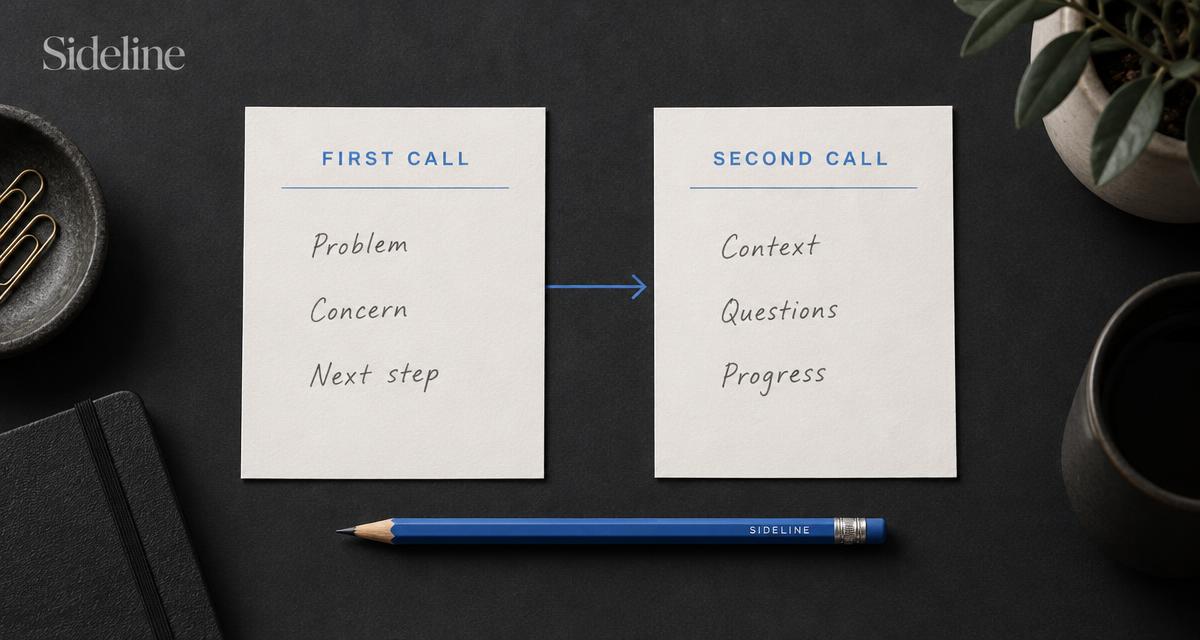
How to Prepare for a Second Sales Call: 7 Steps to Keep B2B Deals Moving
A seven-step preparation checklist, 30-minute agenda, practical questions, and a reusable pre-call brief for your next B2B conversation.