Founder-Led Sales
How to Prepare for a Second Sales Call: 7 Steps to Keep B2B Deals Moving
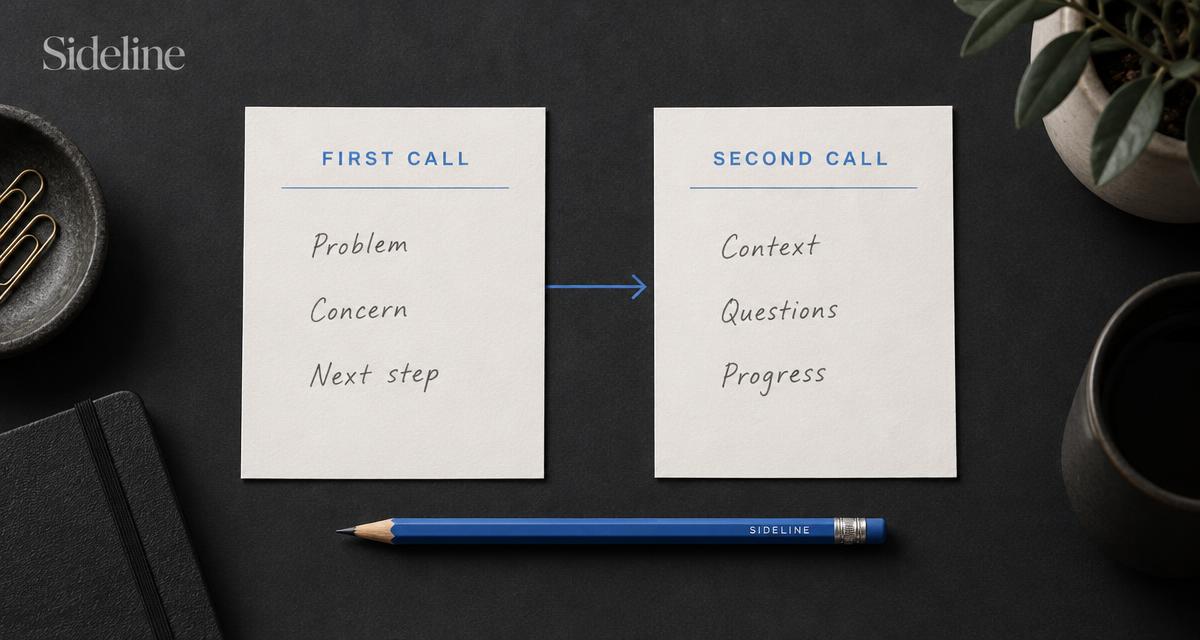
The first sales call went well.
The prospect described a problem. You showed them enough to get interested. They agreed to meet again.
Now it's time for the second call.
You open your notes five minutes before the meeting.
You remember the company. You remember they seemed interested. You vaguely remember something about a budget constraint.
But you can't remember exactly what they said.
So you join the meeting and start with:
"Great to reconnect. Can you remind me what you're hoping to accomplish?"
That's not necessarily a terrible question.
But if the prospect already spent 30 minutes explaining their situation, you shouldn't need them to start from scratch.
The second sales call should build on the first one, not repeat it.
For B2B founders and account executives, the ability to carry context between conversations is one of the most valuable sales habits to develop.
Here's how to prepare for your second sales call, what questions to ask, and how to keep a promising opportunity moving forward.
What Is the Goal of a Second Sales Call?
The first sales call is usually about understanding the prospect's situation.
You're trying to learn what they need, why it matters, and whether your solution might be relevant.
The second call should help both sides make progress toward a decision.
Depending on what happened previously, that could mean:
- Exploring a problem you didn't fully understand.
- Demonstrating how your product addresses a specific need.
- Involving additional stakeholders.
- Reviewing technical or implementation requirements.
- Understanding the buying process.
- Resolving an important concern.
- Agreeing on an evaluation or next step.
Not every second call needs to be a product demo.
And not every promising first call represents a qualified opportunity.
The purpose of the second call is to resolve the most important uncertainties from the first conversation.
That starts with preparation.
Step 1: Review What the Prospect Actually Said
Before preparing another pitch, review the first conversation.
Not just the summary.
The actual substance of what the prospect said.
Look for five things:
- What problem are they trying to solve?
- How are they handling it today?
- Why does the problem matter?
- What concerns did they raise?
- What did both sides agree to do next?
If you have a recording or transcript that was captured with the appropriate consent, revisit the relevant portions.
If you don't, use your meeting notes, CRM records, and email correspondence.
Try to separate confirmed information from your own assumptions.
For example:
Confirmed: "The prospect said their onboarding process takes approximately three weeks."
Assumption: "They'll probably pay to reduce onboarding time."
Those are not the same thing.
The first is information from the buyer.
The second is a hypothesis you still need to test.
You should enter the second call knowing which details are established and which ones require clarification.
A useful habit
After every meaningful sales conversation, record the three most important things you learned.
Then note the three biggest questions you still need answered.
That alone can make your next conversation more focused.
Step 2: Identify What You Missed During Discovery
A first discovery call rarely answers everything.
Maybe you understood the prospect's problem but never established its business impact.
Maybe you learned they need a new solution but didn't understand their timeline.
Maybe someone mentioned procurement, and you moved on without asking about the approval process.
These aren't necessarily failures.
They're opportunities to improve your next conversation.
Before the second call, identify the most important discovery gaps.
For example:
| What You Know | What's Still Missing |
|---|---|
| Current onboarding takes three weeks | What happens when onboarding is delayed? |
| The team uses spreadsheets | Why haven't existing tools solved the problem? |
| The VP of Operations is interested | Who approves the budget? |
| They want to improve the process | Is there a target implementation date? |
Don't turn the second meeting into an interrogation.
Prioritize the questions that actually affect whether and how the prospect could move forward.
If you need help with initial discovery, read our guide to how to run a B2B discovery call.
Step 3: Revisit Objections and Unresolved Concerns
One of the easiest ways to lose credibility is to forget an important concern the prospect raised.
Imagine the buyer said this on your first call:
"We like the product, but migrating our existing data would be a major concern."
You acknowledge it and promise to discuss implementation later.
On the second call, you deliver a polished 20-minute product demo.
But you never mention migration.
From your perspective, the meeting might feel successful.
From the buyer's perspective, the biggest obstacle to moving forward is still unresolved.
Before the second call, make a list of previous concerns.
Those might involve:
- Price or budget
- Technical compatibility
- Security requirements
- Implementation effort
- Existing vendors
- Internal resources
- Adoption by the team
- Purchasing approvals
For each concern, ask yourself:
What would the prospect need to learn or see to feel more confident about this issue?
If you know the answer, prepare the relevant information.
If you don't, prepare a question.
For example:
"Last time, you mentioned concerns about migrating your existing data. Can we spend a few minutes understanding what would make that process difficult for your team?"
This shows that you listened, remembered, and prepared.
It also prevents you from assuming the concern has disappeared simply because the prospect agreed to another meeting.
Step 4: Understand Who Needs to Be Involved
The person who attends your first discovery call may not be the person who approves the purchase.
In B2B sales, the buying process can involve multiple people with different concerns.
The user might care about ease of use.
The team manager might care about productivity.
IT might care about security and implementation.
Finance might care about cost and purchasing requirements.
Before the second call, review what you know about the decision-making process.
Ask yourself:
- Who is attending the next meeting?
- What does each participant care about?
- Is anyone missing from the conversation?
- Who can approve the purchase?
- Who could block implementation?
- Does the prospect know what the evaluation process involves?
You don't need to force every stakeholder onto the second call.
But you should understand who will eventually need to participate.
A useful question is:
"If we determine this could work for your team, who else would need to be comfortable with the decision?"
That's often more productive than immediately asking:
"Are you the decision-maker?"
The goal is to understand the process, not challenge the person's authority.
Step 5: Build Your Agenda Around Their Priorities
A common mistake is preparing a second call around everything you want to show.
Instead, prepare around what the buyer needs to understand.
Consider two possible agendas.
Product-centered agenda
- Company introduction
- Product overview
- Feature walkthrough
- Pricing
- Questions
There's nothing inherently wrong with this structure.
But it doesn't demonstrate that you've learned anything from the previous meeting.
Buyer-centered agenda
- Confirm what you learned last time
- Revisit the main problem
- Address the buyer's implementation concern
- Demonstrate the two workflows most relevant to their situation
- Discuss the evaluation process and next steps
The second agenda is much more specific.
It gives the prospect a clear reason to spend another 30 minutes with you.
Example: 30-minute second sales call agenda
| Time | Focus | Objective |
|---|---|---|
| 0–3 minutes | Reconnect and confirm agenda | Align on priorities |
| 3–8 minutes | Review previous discussion | Confirm what has changed |
| 8–18 minutes | Focused demo or problem exploration | Address the buyer's key need |
| 18–24 minutes | Questions and objections | Resolve important uncertainties |
| 24–30 minutes | Buying process and next steps | Agree on a useful action |
Treat this as a flexible framework.
If your second meeting is primarily a technical evaluation, you may spend most of the time discussing integration requirements.
If the first call left major discovery gaps, you may need another discovery-focused conversation instead of a demo.
The agenda should follow the buyer's needs, not the other way around.
Step 6: Prepare Three Questions You Don't Want to Forget
You don't need 25 scripted questions for every meeting.
In fact, an overly detailed question list can distract you from listening.
Try preparing just three questions that would materially change your understanding of the opportunity.
For example:
Question 1: Business impact
"Last time, you mentioned that onboarding delays were becoming a problem. What does that delay affect most?"
Question 2: Decision process
"You mentioned your IT team would need to review this. What would they need to evaluate?"
Question 3: Timeline
"Is there a particular event or deadline driving when you'd want a solution in place?"
These questions are useful because they build on information the prospect has already shared.
They also help you avoid repeating introductory discovery.
Don't memorize the questions word for word
The actual conversation may move in a different direction.
That's fine.
The goal is to remember the information you need, not deliver a scripted performance.
A relevant follow-up to something the prospect just said is usually more valuable than forcing your next prepared question.
This is also one of the challenges that real-time AI sales coaching is designed to address.
A contextual prompt during the meeting may help a seller recognize a question they otherwise would have missed.
Step 7: Define What Progress Would Actually Look Like
Before joining the second call, ask yourself:
"What would make this conversation worthwhile for both sides?"
The answer shouldn't automatically be "get the deal closed."
Most B2B purchases involve several steps.
Progress might mean:
- Confirming that the product solves the buyer's main problem.
- Resolving an implementation concern.
- Bringing in a relevant stakeholder.
- Agreeing on evaluation criteria.
- Establishing whether budget exists.
- Scheduling a technical review.
- Understanding why the opportunity isn't a fit.
The last outcome matters too.
A clear answer that a deal shouldn't move forward can be more valuable than several additional meetings with no real buying intent.
Make next steps specific
Compare these two endings.
Vague:
"Great conversation. Let's stay in touch."
Specific:
"I'll send the security documentation by Thursday. You'll review it with IT, and we'll reconnect next Tuesday to discuss whether a pilot makes sense."
The second creates clarity.
But only use it if both parties actually agreed to those commitments.
Don't invent agreement or urgency to make the CRM look healthier.
Once the meeting ends, send a follow-up that reflects what was discussed.
Our sales call follow-up email templates provide examples for discovery calls, demos, pricing conversations, and stalled opportunities.
A Reusable Second Sales Call Preparation Template
Here's a practical briefing template you can copy before your next meeting.
You can use it in a document, CRM note, or whatever system you already work in.
Second Sales Call Brief

Company: [Company name]

Prospect: [Name, title]

Meeting date: [Date]

Meeting purpose: [Why we're meeting again]

1. What we learned last time

- Main business problem:
- Current process or solution:
- Impact of the problem:
- Why they're evaluating alternatives:

2. Previous objections or concerns

- Concern #1:
- Concern #2:
- Current status of each concern:

3. Decision process

- Known stakeholders:
- Approval requirements:
- Missing information:

4. Commitments from the last call

- What I promised:
- What the prospect promised:
- Status of each commitment:

5. Three questions to ask

1. [Question]
2. [Question]
3. [Question]

6. Proposed agenda

- Confirm priorities
- Address open questions
- Review relevant solution
- Agree on next steps

7. Desired outcome

[What useful progress looks like for this meeting]

8. Still unknown

[Information that has not been established]
You don't need to spend an hour preparing this document.
For a straightforward opportunity, a few minutes may be enough.
The goal is to walk into the meeting with the relevant context readily available.
The Real Challenge: Remembering Context Across Multiple Calls
Preparing for one second call is manageable.
Now imagine you're an account executive managing 15 active opportunities.
Each deal involves different stakeholders, priorities, concerns, and timelines.
One prospect is worried about implementation.
Another needs CFO approval.
A third is waiting for a contract to expire.
A fourth mentioned a security requirement during a call two weeks ago.
It's not realistic to remember every detail without a system.
And even when the information is saved somewhere, you still need to retrieve it before the right conversation.
This is where sales-call memory becomes particularly important.
Not memory in the sense of storing every word someone has ever said.
Useful memory means retaining the information that should influence what happens next.
That includes:
- Previous concerns
- Decision criteria
- Open discovery questions
- Stakeholder responsibilities
- Outstanding commitments
- Relevant changes in priorities
- Repeated gaps in the seller's approach
For founders running their own sales processes, maintaining that context can be especially challenging.
You're often responsible for selling, building, supporting customers, and managing the business.
You don't have a sales manager preparing a briefing before every call.
And you may not have time to reread five transcripts before speaking with a prospect.
That's the problem we're interested in solving with Sideline.
If you're exploring software to support this workflow, our guide to the best AI sales coaching tools compares different approaches to live guidance, call analysis, and practice.
How Sideline Is Building Coaching That Carries Across Calls
Most people think of AI meeting software as something that takes notes or summarizes conversations.
Those capabilities are useful.
But they only address part of the problem.
We're building Sideline around a different idea:
Your sales coach should remember what happened last time.
Sideline is a native macOS AI sales coach designed for founders and individual B2B sellers.
During a conversation, it provides short, contextual coaching prompts designed to help you recognize missed questions, objections, and important buying signals.
After the call, it provides a coaching debrief that helps you understand what went well, what was missed, and what needs attention.
Sideline also maintains prospect and call history, and we're refining how that history influences coaching during later conversations.
The goal is to make prior context useful while you're actually selling.
Imagine this second-call scenario
On your first call, the prospect says:
"We're interested, but I need our operations lead to sign off on implementation."
You finish the conversation and agree to meet the following week.
During the next call, you're discussing product features when the prospect mentions that deployment could take several months.
A useful coaching prompt might be:
"Last call, ops approval was unresolved. Ask what implementation needs their sign-off."
That's an illustrative example of the cross-call coaching experience we're working to develop, not a claim that every beta session will produce that exact suggestion.
The important part isn't just remembering the operations lead.
It's connecting previous context to the conversation happening right now.
Not all AI coaching tools approach memory and call preparation the same way. Our Sideline vs. Convo comparison explores how two real-time sales assistants handle context across conversations.
Coaching the seller, not just remembering the buyer
We're also interested in patterns across the seller's conversations.
If you repeatedly avoid asking about the decision-making process, that may be a skill worth working on.
If you regularly fail to establish business impact, that should inform your coaching focus.
Sideline's coaching focus and pattern-tracking experience is designed to help individual sellers recognize these habits and improve over time.
We're still refining these capabilities in private beta.
Our goal isn't to replace human judgment, automate entire conversations, or guarantee better sales outcomes.
It's to help people show up better prepared, ask more useful questions, and learn from each meeting.
Second Sales Call Preparation Checklist
Use this checklist before your next B2B sales meeting:
- I know the main problem discussed on the first call.
- I understand what the buyer has said about its impact.
- I've identified the most important unanswered questions.
- I remember the objections raised previously.
- I've checked any commitments made during the last conversation.
- I know who is attending and why.
- I understand which stakeholders may still need to be involved.
- I've prepared a relevant meeting agenda.
- I have three important questions ready.
- I know what useful progress would look like.
- I've prepared the resources the buyer requested.
- I can distinguish confirmed facts from assumptions.
The point isn't to check every box mechanically.
It's to avoid walking into a meeting without the information you need to make the conversation useful.
Frequently Asked Questions
What should I discuss on a second sales call?
Focus on the most important issues left open after the first conversation. These may include the business impact of a problem, product fit, implementation requirements, stakeholders, buying process, or evaluation criteria.
Should the second sales call be a demo?
Not necessarily. A demo may make sense if you've already established a relevant problem and the buyer wants to evaluate the product. If major discovery questions remain unanswered, additional discovery may be more useful.
How long should a second sales call last?
Thirty minutes is a reasonable starting point for many B2B meetings, but technical evaluations and detailed product demonstrations may require more time. Match the meeting length to its purpose.
What questions should I ask on a second sales call?
Ask questions that build on what you've already learned. Explore unresolved concerns, business impact, stakeholders, decision criteria, and timing. Avoid repeating introductory questions unless circumstances have changed.
How do I follow up after a second sales call?
Summarize the relevant points, confirm any commitments, and identify the next agreed action. If the buying process has advanced, make sure the next step reflects that progress.
How do I prepare for multiple sales calls each day?
Maintain consistent notes, track commitments, and review a concise pre-call brief before each meeting. Prioritize the details that could materially affect the conversation rather than rereading every previous transcript.
Can AI help prepare for a second sales call?
Yes. AI tools can help summarize previous conversations, surface open questions, and prepare meeting briefs. Some also provide live coaching. Verify important details against actual conversation records, especially commitments and statements attributed to buyers.
Final Thoughts
The second sales call is where many promising conversations either gain momentum or begin to drift.
The difference often comes down to preparation.
You don't need a complicated framework.
You need to understand what the buyer already told you, remember what still needs to be addressed, and show up ready to move the conversation forward.
Because a great second sales call shouldn't feel like a new introduction.
It should feel like the next chapter of a conversation that matters.
And that's the kind of selling experience we're building Sideline to support.
Better calls. Better context. Better selling.
Sideline · Private beta
Stop starting every sales call from scratch.
Meet Sideline, a personal AI sales coach for founders and B2B sellers. Join our private beta and help shape the experience.
Join the Sideline Beta
How to Run a B2B Discovery Call: A Practical Guide for Founders
A 30-minute agenda, 12 practical questions, and a better way to understand what your buyer really needs.

Sales Call Follow-Up Emails: 6 Templates That Keep B2B Deals Moving
Six practical B2B follow-up email templates for discovery calls, demos, pricing discussions, and stalled deals — plus a simple post-call checklist.

Real-Time AI Sales Coaching: How It Works and Why It Matters
How live AI coaching works during a sales call, how it compares to post-call analysis, and where it helps founders and reps most.