Objection Handling
How to Identify and Handle Sales Objections: A B2B Seller's Playbook

The demo went well. The prospect nodded through the workflow, asked about implementation, and said the product looked useful.
Then you ask about next steps.
“We're probably not ready for this right now.”
There are two ways to respond. You could launch into a prepared speech about why your product deserves attention. Or you could find out what “not ready” actually means.
Maybe timing is the real issue. Maybe the buyer has no approved budget. Maybe they like the product but don't trust that their team will adopt it. Or maybe the problem simply isn't important enough.
The objection you hear isn't always the objection you need to solve.
Effective B2B objection handling starts with understanding, not rebuttal. Here's a practical framework and eight examples you can use in your own calls.
What is a sales objection?
A sales objection is a concern, question, constraint, or reason a prospect gives for hesitating to move forward.
Some objections are about the solution: price, security, integrations, or functionality. Others are about the decision: timing, authority, internal priorities, or perceived risk.
Objections aren't automatically bad. A buyer asking hard implementation questions may be seriously evaluating a purchase. Someone who says “looks great” and never commits to another step may be much less ready.
The goal isn't to eliminate objections. It's to understand whether there's a credible path forward for both sides.
Objection, question, or disqualification?
Before responding, determine what kind of information you've received.
| What you hear | It might mean | Your next move |
|---|---|---|
| “How do you handle security?” | Evaluation requirement | Learn the exact security criteria |
| “We already have a vendor.” | Switching cost or low urgency | Ask what is or isn't working |
| “It's too expensive.” | Budget, value, or negotiation | Clarify the reference point |
| “No one here owns this problem.” | Weak buying process | Explore who is affected and accountable |
| “We're contractually unable to switch.” | Genuine constraint | Respect the limitation and timing |
Not every obstacle is a persuasion challenge. Sometimes “no” is an accurate conclusion about fit, and accepting that conclusion saves both sides time.
A four-step framework for handling objections
| Step | What you do |
|---|---|
| 1. Listen | Let them finish without rushing to fill the silence |
| 2. Clarify | Ask one question that separates possible interpretations |
| 3. Explore | Respond with evidence and options relevant to that issue |
| 4. Agree | Settle on a meaningful next step both sides understand |
Many objections are easier to understand when the buyer's needs were explored early. If you want fewer surprises late in the process, run a better discovery call.
1. Listen without rushing to fill the silence
When a prospect raises a concern, don't immediately defend the product. Let them finish. Repeat the specific concern in plain language if you need to confirm it.
Example: “So your main concern is the amount of work your team would need to put into implementation?”
2. Clarify the real issue
Ask one useful question that separates possible interpretations.
Example: “Is the timeline itself the problem, or is it the amount of engineering support the rollout would require?”
Avoid a string of leading questions designed to trap the buyer into saying yes.
3. Explore evidence and options
Once you understand the issue, respond with material relevant to that issue: a documented security process, the correct technical answer, a supported pilot option, a realistic trade-off, or an honest admission that your product isn't the right fit.
Example: “If we could show the implementation steps and responsibilities, would that help you evaluate the effort?”
Don't promise features or outcomes that aren't available.
4. Agree on a meaningful next step
An objection is only resolved when both sides have the information they need, not when the seller wins a verbal argument.
Example: “I'll send the architecture overview. If it addresses the data-handling questions, could we involve your security lead next week?”
A buyer might still decide not to proceed. That's fine.
Eight common B2B sales objections and how to respond
These examples are starting points, not scripts to repeat verbatim. Use the prospect's actual situation to choose the next question.
1. “It's not a priority right now.”
Don't jump to: “This only takes 15 minutes to set up.”
Try: “What else is taking priority, and what would have to change for this to matter more?”
A lack of urgency may reflect a genuine business decision. Find out whether there's a deadline, an operational change, or a cost of inaction. If none exists, a later check-in may be more appropriate than another demo.
2. “We already use another solution.”
Don't jump to: “We're better than that vendor.”
Try: “What's working well with it, and what made you interested in looking at alternatives?”
This reveals whether a buyer has an unresolved problem. It also shows respect for the work that went into choosing the current vendor. If their existing tool meets their needs, don't invent a reason to switch.
3. “Your product is too expensive.”
Don't jump to: “I can discount it.”
Try: “What are you comparing the price against?”
Then explore whether the issue is the budget, the value, the scope, or the decision process. This objection deserves its own deep dive: see our guide to handling price objections without immediately discounting.
4. “Just send me some information.”
Don't jump to: Sending five generic PDFs and hoping they respond.
Try: “Happy to. Which part would be most useful for you to evaluate?”
Sometimes this means genuine interest with limited time. Other times it is a polite way to end the call. Asking what information matters helps distinguish the two without putting the buyer on the spot.
If they identify a concrete requirement, send a relevant resource and agree on what happens after they review it. Our sales follow-up email templates can help make that step clear.
5. “I'm concerned implementation will be difficult.”
Don't jump to: “Implementation is easy.”
Try: “Which part of the rollout feels most risky for your team?”
The concern may relate to data migration, integrations, training, downtime, or limited internal resources. Each requires different evidence. If you cannot verify the answer during the call, say you'll follow up rather than guessing.
6. “Our security team will never approve this.”
Don't jump to: “Everyone else approves us.”
Try: “What specific requirements would they need us to meet?”
Security isn't merely a sales objection to overcome. It can be a real acceptance criterion. Get the right people involved, document requirements, and be transparent about what your product can and cannot support.
Never misrepresent compliance certifications, audit status, data processing, or retention policies.
7. “I need to talk to my boss.”
Don't jump to: “But aren't you the decision-maker?”
Try: “Of course. What would your manager need to understand to make an informed decision?”
This explores the buying group without undermining your contact. You can also ask if it would help to prepare a brief summary or have a focused follow-up with the relevant stakeholder.
The objective is a better evaluation process, not pressure to bypass internal approvals.
8. “I'm not sure our team will actually use it.”
Don't jump to: “Everyone loves our interface.”
Try: “What has made adoption difficult with tools like this in the past?”
A buyer may have invested in software that employees ignored. Understand whether the risk is workflow fit, training time, competing tools, or skepticism about the value. Then discuss what adoption evidence or test would be needed. A small pilot can be sensible if the product supports one and success criteria are clear.
Three mistakes that make objections harder
Defending features instead of understanding consequences
A buyer says their team lacks visibility, and you show a dashboard. But you never learn what the lack of visibility actually affects. Go back to the business problem before giving another feature tour.
Treating every objection as an invitation to negotiate
A price cut won't fix a security gap. A discount won't give a prospect a budget owner. Diagnose first.
Forgetting the objection on the next call
A buyer raises implementation risk during discovery. Two meetings later, you're discussing a proposal as if the risk never existed. Keep a record of unresolved concerns, owners, and next steps. That's part of making a sales process coherent.
For the preparation work between meetings, read our second sales call preparation guide.
How to recognize an objection in the moment
The hardest objections aren't always announced with “I object.” Often they sound like normal conversation:
- “We've had trouble rolling out tools in the past.”
- “Our CFO would probably need to see this.”
- “That's different from how our current vendor handles it.”
- “We wouldn't be able to change anything until next quarter.”
Those statements may reveal risk, decision criteria, or timing. The better move is often to ask a short follow-up before changing topics.
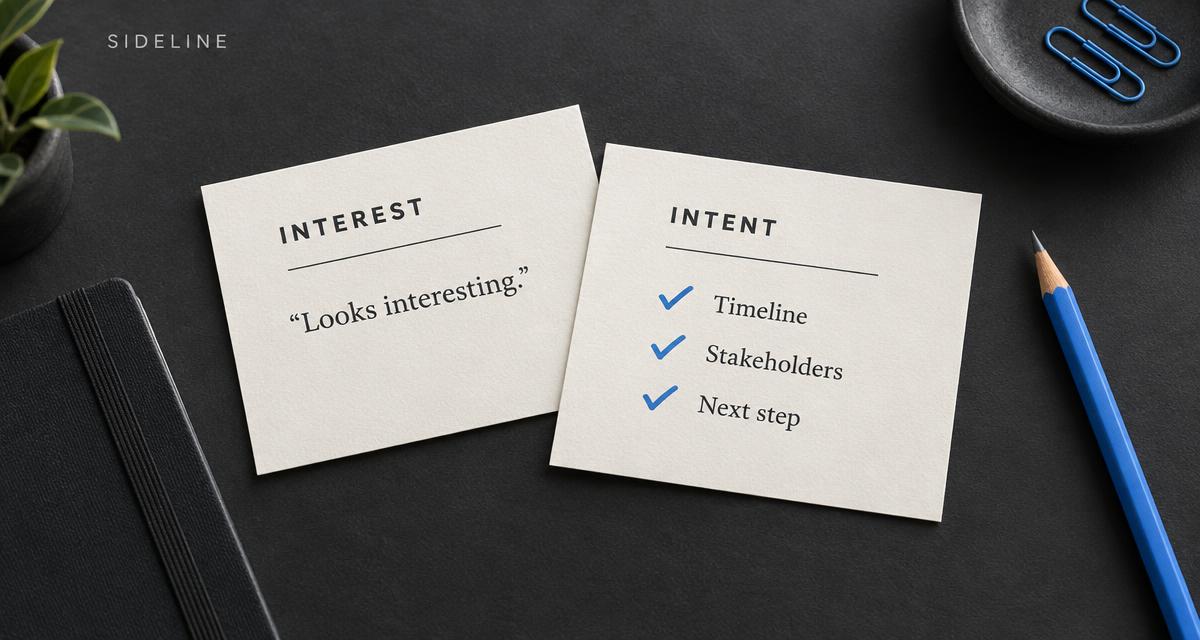
Buying signals and objections can also appear together. A prospect asking about security may be actively evaluating your product while still facing a blocker. Our article on questions that reveal buying intent explains how to distinguish polite interest from real evaluation progress.
A simple objection tracker for your next call
After each meaningful objection, capture:
- Exact concern: What did the buyer actually say?
- Underlying issue: What did clarification reveal?
- Evidence needed: What would help them evaluate?
- Owner: Who will supply or assess that evidence?
- Status: Open, being reviewed, resolved, or no fit?
- Next check-in: When should this be revisited, if appropriate?
Avoid marking an objection resolved simply because you delivered an answer. Check whether the buyer considers the concern addressed.
How Sideline approaches objection coaching
We're building Sideline as a Mac-first AI sales coach for founders and individual B2B sellers.
During a call, Sideline is designed to surface short, contextual questions when an objection, discovery gap, or buying signal deserves attention.
Illustrative example:
Prospect: “I like the concept, but our operations team would need to approve it.”
Sideline-style prompt: “Ask what operations would need to review.”
After the meeting, the debrief helps the seller examine what they explored, what they missed, and what remains unresolved. Sideline maintains prospect and call history, while we're refining how prior objections and repeated selling habits shape later coaching.
The product is in private beta. These workflows are being improved, and no AI suggestion should substitute for a seller's own judgment or accurate technical information.
For more about the live experience, read how real-time AI sales coaching works.
FAQs
What are the most common sales objections?
Budget, priority, competition, implementation effort, security, stakeholder approval, product fit, and adoption are all common themes. Their importance depends on the buyer and product.
Should I always try to overcome an objection?
No. Some concerns reveal that the product isn't a good fit or the organization cannot proceed. A useful qualification process respects those constraints.
What's the best objection handling technique?
Clarify what the buyer means before responding. Then address the actual concern using relevant evidence and agree on an appropriate next step.
How do I respond to “send me information”?
Ask what information they would find useful and why. Send material that matches the concern and avoid assuming the buyer agreed to another meeting.
Can AI help with sales objections live?
Some AI sales coaches analyze live conversations and suggest questions. Accuracy and usefulness vary, so the seller should decide whether a suggestion fits the situation.
Final thoughts
The objective of objection handling isn't to win every conversation. It's to learn what stands between the buyer and a good decision, then determine whether you can responsibly help.
Often the best move is not a rebuttal. It's one more relevant question.
Sideline · Private beta
Better questions during the call. Better clarity afterward.
Sideline is a Mac-first AI sales coach for founders and B2B sellers, now in private beta.
Join the Sideline Beta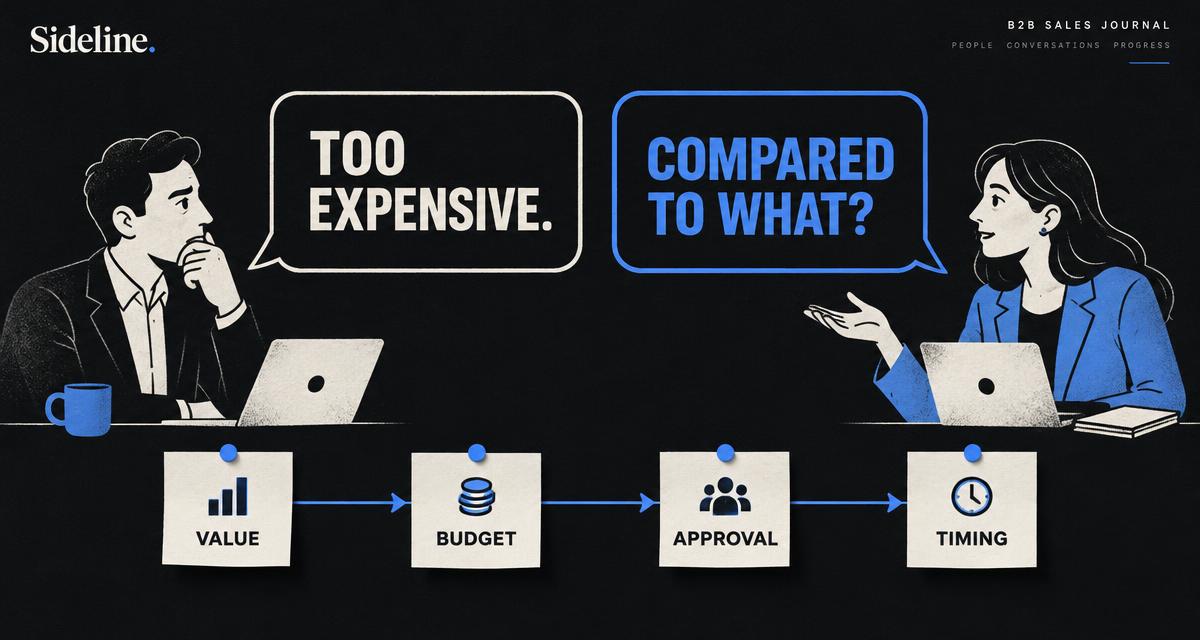
How to Handle "Too Expensive" on a Sales Call (Without Immediately Discounting)
Seven practical responses to "too expensive," with conversation examples and questions that uncover the buyer’s actual concern.
15 Sales Questions That Reveal Buying Intent (Not Just Interest)
15 practical B2B sales questions to uncover urgency, decision criteria, obstacles, and genuine buying intent beyond polite interest.

Sales Call Follow-Up Emails: 6 Templates That Keep B2B Deals Moving
Six practical B2B follow-up email templates for discovery calls, demos, pricing discussions, and stalled deals — plus a simple post-call checklist.