Objection Handling
How to Handle "Too Expensive" on a Sales Call (Without Immediately Discounting)
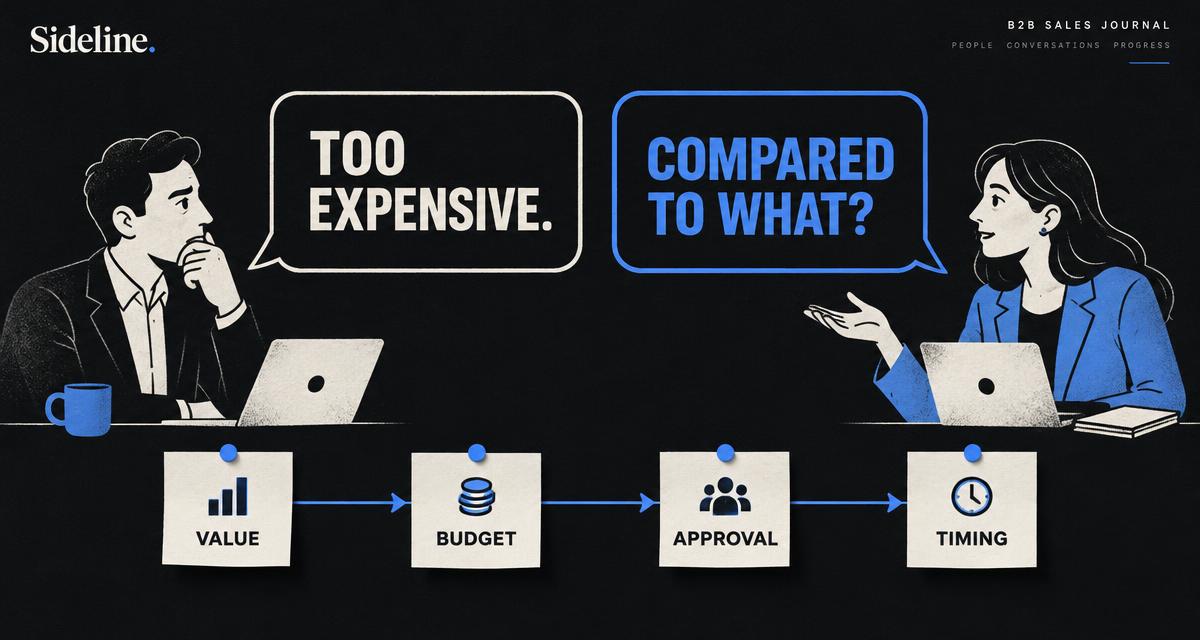
You're twenty minutes into a sales call.
The demo went well. The prospect seems engaged. You've explained how your product can solve a problem they've been struggling with.
Then you get to pricing.
You tell them the cost.
They pause.
"That's pretty expensive."
And suddenly, the conversation feels different.
Your instinct might be to justify the price.
You start explaining features. You mention everything included in the subscription. Maybe you offer a discount before they've even asked for one.
But there's a problem.
You don't actually know what "too expensive" means to this buyer.
They might not have the budget.
They might not understand the value.
They might be comparing you to a cheaper competitor.
Or they might simply be testing whether your price is negotiable.
Those are very different situations, and they require different responses.
The mistake isn't hearing a price objection.
It's responding before understanding what the prospect actually means.
Here's how to handle pricing objections in B2B sales without immediately discounting your product.
First, Understand What "Too Expensive" Actually Means
When someone says your product is too expensive, it's tempting to treat that statement as a request for a lower price.
Sometimes it is.
But often, price is simply the easiest way for a buyer to express uncertainty.
Consider these five situations.
| What the Prospect Says | What Might Actually Be Happening |
|---|---|
| "That's too expensive." | They don't yet understand the business value |
| "We don't have the budget." | The purchase may not be funded or prioritized |
| "Your competitor is cheaper." | They're comparing different products or levels of value |
| "I can't justify that internally." | They need a stronger business case or stakeholder support |
| "Can you do better on price?" | They're negotiating commercial terms |
Each situation deserves a different conversation.
If the prospect doesn't understand the value, lowering the price may not solve the underlying problem.
If the budget genuinely doesn't exist, repeating your value proposition won't create money the organization doesn't have.
If the buyer is negotiating, offering a discount immediately may weaken your position without creating any meaningful commitment.
Before you defend your price, diagnose the objection.
That starts with asking better questions.
7 Ways to Handle Price Objections on a Sales Call
These techniques are intended for B2B founders, account executives, and other sellers navigating real pricing conversations.
They're not scripts to memorize word for word.
Think of them as different approaches depending on what the prospect is telling you.
1. Ask What They're Comparing the Price Against
Prospect: "Honestly, that's pretty expensive."
Seller: "Totally fair to evaluate the cost. What are you comparing it against?"
This is one of the simplest and most useful questions you can ask.
The prospect may reveal they're comparing you against:
- An existing vendor
- A lower-cost competitor
- Their current manual process
- An internal solution
- A previously approved budget
- Their expectations of what this category should cost
That information changes the conversation.
Imagine you're selling a $500-per-month SaaS product.
The buyer says:
"We already have a tool that costs $150 per month."
Now you have a much more useful starting point.
You can explore what the existing tool does, where it falls short, and whether your product provides enough additional value to justify the difference.
But if your product doesn't deliver meaningful additional value for that buyer, the cheaper solution might genuinely be the better choice.
That's worth knowing.
Why it works: You're investigating the buyer's reference point rather than assuming the objection is about affordability.
2. Separate Budget Constraints From Value Concerns
Two prospects can say the same sentence and mean completely different things.
Prospect A: "We don't have the money allocated for this."
Prospect B: "I'm not convinced this is worth what you're charging."
The first is a funding or budget issue.
The second is a value question.
They shouldn't receive the same pitch.
Try asking:
Seller: "Is the main concern that the budget isn't available, or that we haven't established enough value to justify the investment?"
This gives the buyer room to clarify.
If the problem is budget, explore how the company handles purchasing decisions and whether the initiative has an approved funding path.
If the problem is value, revisit the outcomes the buyer cares about.
You might ask:
"Which part of the expected outcome doesn't feel strong enough to justify the cost?"
That's much more useful than delivering another generic product pitch.
Why it works: You distinguish the ability to purchase from the willingness to purchase.
3. Revisit the Business Problem Before Defending the Price
One of the most common mistakes in SaaS sales is explaining the price in terms of features.
"We include unlimited dashboards, automation, analytics, and integrations."
That may describe the product accurately.
But it doesn't necessarily explain why the buyer should spend money.
Instead, return to the problem they described.
Prospect: "I'm not sure we can justify $800 per month."
Seller: "Earlier, you mentioned your team is spending a lot of time reconciling customer records. How significant is that problem for the business today?"
If the buyer can describe the impact, you can explore whether addressing it would justify the cost.
For example, they might explain that the process requires several hours of work each week.
You can then evaluate whether your product would realistically reduce that burden.
Don't manufacture a return on investment.
Don't claim your product will save a specific amount of money without evidence.
The goal is to understand whether the expected benefit is meaningful relative to the price.
Sometimes the conclusion will be that the problem isn't expensive enough to justify your solution.
That's a legitimate outcome.
Why it works: You shift from defending features to evaluating the business case.
A strong pricing conversation usually starts with good discovery. Our guide to how to run a B2B discovery call covers the questions that help establish business impact before pricing comes up.
4. Ask What Would Make the Investment Worthwhile
This is useful when the prospect understands the product but still isn't convinced the price makes sense.
Prospect: "I like what you're showing me, but it's a lot to spend."
Seller: "What would you need to see for the investment to feel justified?"
This opens a conversation about success criteria.
The buyer might say:
"We'd need to reduce onboarding time by at least a week."
Or:
"We'd want our managers spending less time manually reviewing calls."
Now you have a clearer evaluation criterion.
You can discuss whether your product is capable of producing that result and what evidence the buyer would need.
Maybe that means a focused demo.
Maybe it means a short pilot with agreed success measures.
Maybe it means sharing relevant documentation or customer evidence that you actually have permission to use.
The important thing is not to promise results just because the buyer names a target.
Why it works: It replaces a vague pricing objection with a concrete question about expected outcomes.
5. Understand Who Needs to Approve the Purchase
Sometimes the person raising the pricing objection isn't actually rejecting the product.
They're anticipating a difficult internal conversation.
Prospect: "I don't think finance is going to approve something this expensive."
Seller: "What would finance need to understand before they could evaluate it?"
That question can reveal the buying process.
Maybe finance requires an ROI analysis.
Maybe the company has a procurement threshold.
Maybe a department head needs to sponsor the purchase.
Or maybe the budget has already been committed elsewhere.
Understanding those requirements helps you determine what information is useful and who should participate in the evaluation.
You could also ask:
"Would it make sense to involve finance in a conversation about the expected outcomes and costs?"
Don't assume that a champion can obtain approval simply because they like the product.
And don't pressure them to make commitments beyond their authority.
Why it works: It identifies the decision process behind the objection.
A pricing question isn't always proof that someone is ready to buy. Our guide to buying signals in sales explains how to distinguish genuine purchase intent from general interest.
6. Explore Scope Before Offering a Discount
Sometimes the buyer genuinely wants the product but can't justify the entire proposed package.
In that case, a smaller starting scope may make more sense than lowering the price of the same package.
Prospect: "We like the platform, but the annual commitment is more than we're comfortable with."
Seller: "Would it make sense to start with a smaller rollout and expand if the results justify it?"
This may lead to options such as:
- Fewer initial users
- A narrower implementation scope
- A smaller team or department
- A clearly defined pilot
- A phased rollout
Only offer options your company actually supports.
The goal isn't to disguise a discount.
It's to find a commercially sensible way to match the scope of the solution to the buyer's immediate needs.
For an early-stage SaaS founder, that might mean selling to one team before attempting an organization-wide deployment.
A smaller, successful implementation may also provide useful evidence for future expansion.
But not every product supports modular pricing or phased deployments.
If yours doesn't, don't invent an option during the call.
Why it works: It changes the proposed scope rather than automatically devaluing the same offering.
7. Know When to Walk Away
Not every price objection is something you should overcome.
Price is one type of objection. Our broader guide to handling sales objections covers eight common B2B concerns.
Sometimes the prospect genuinely cannot afford the product.
Sometimes the problem isn't important enough.
Sometimes the cheaper competitor is a better fit.
And sometimes the buyer simply doesn't have a compelling reason to make a change.
For example:
Prospect: "We like what you've built, but this isn't a priority and we're unlikely to fund it this year."
Seller: "That makes sense. It sounds like the timing isn't right. Would it be useful to reconnect if this becomes a priority later?"
You don't need to manufacture urgency.
You don't need to repeatedly defend the price.
And you don't need to discount a product until an unqualified prospect agrees to something.
A clear disqualification can be better than months of follow-ups that go nowhere.
Why it works: Good selling includes recognizing when there isn't a viable opportunity.
A Practical Framework for Responding to "Too Expensive"
When you hear a pricing objection, you don't need to choose a clever rebuttal immediately.
Use this four-step approach.
Step 1: Acknowledge the concern
Don't argue with the buyer.
Try:
"I understand. It's important to make sure the investment makes sense."
Keep it natural. Avoid sounding like you're reading from a negotiation script.
Step 2: Clarify the meaning
Ask one question to understand the actual concern.
Examples:
- "What are you comparing the price against?"
- "Is this primarily a budget constraint or a value concern?"
- "What would need to change for the investment to make sense?"
Then listen.
Step 3: Explore the underlying issue
Once you know the concern, follow the relevant path.
If it's value, discuss the problem and desired outcome.
If it's budget, explore the purchasing process.
If it's competition, understand the alternative.
If it's implementation risk, determine what evidence would reduce uncertainty.
Don't answer a question the prospect hasn't actually asked.
Step 4: Agree on a meaningful next step
A useful next step might be:
- Reviewing the business case
- Involving another stakeholder
- Comparing product requirements
- Evaluating a smaller scope
- Running a pilot with defined criteria
- Reconnecting when the timing changes
The next step should reflect what the buyer actually needs to decide.
Not just what you need to move a CRM opportunity to the next stage.
Once you've clarified the objection and agreed on the next action, use these sales call follow-up email templates to document the discussion and commitments.
Should You Ever Offer a Discount?
Yes. Discounts can be commercially appropriate.
But they should be intentional.
A discount may make sense when there's a legitimate reason, such as an approved promotion, a larger commitment, a different contract structure, or a customer relationship with broader strategic value.
The mistake is treating every pricing objection as a signal to reduce the price.
Before offering a discount, ask yourself:
- Have I established the product's value for this buyer?
- Do I understand why the prospect is asking?
- Would a lower price actually resolve the concern?
- Are the proposed terms commercially sustainable?
- Am I authorized to offer this discount?
- Is there a clear, mutually agreed decision process?
If you're selling your own SaaS product, remember that the first few customers can influence your future pricing assumptions.
Discounting may sometimes be useful for learning or distribution, but it can also make it harder to understand the willingness to pay of your ideal customers.
Consider the full relationship and economics rather than reacting to discomfort in the moment.
Three Pricing Objection Mistakes That Can Hurt a Deal
Mistake 1: Immediately defending your features
Prospect: "That's expensive."
Seller: "Well, we have AI automation, analytics, dashboards, integrations, reporting, and unlimited users."
The prospect hasn't explained the concern yet.
Listing features may simply create more noise.
Better response: "What are you comparing it against?"
Mistake 2: Discounting before understanding the objection
Prospect: "I'm not sure about the price."
Seller: "I can take 20% off."
You may have lowered the price without addressing the actual concern.
Perhaps the buyer doesn't believe the product solves their problem.
Perhaps they need security approval.
A lower price won't necessarily resolve either issue.
Better response: "What feels hardest to justify about the investment?"
Mistake 3: Treating every objection as a negotiation tactic
Some prospects genuinely have financial constraints.
Others have already invested in an alternative.
Not every objection is a tactic, and not every buyer needs to be persuaded.
Respecting those constraints makes the conversation more useful for both parties.
Why Price Objections Are Difficult During Live Sales Calls
Handling pricing objections is relatively easy to explain after the meeting.
It's harder while you're actually in the conversation.
You're thinking about your product.
You're wondering whether the deal is at risk.
You're trying to respond without sounding defensive.
And sometimes, the silence after a prospect says "too expensive" makes you uncomfortable enough to start talking immediately.
That can lead to one of two mistakes:
You start defending the product before understanding the concern.
Or you offer a discount without knowing whether price is actually the problem.
The better move is often to ask one more question.
But recognizing that moment while you're on the call isn't always easy.
This is one of the reasons real-time AI sales coaching is an interesting approach.
Instead of only reviewing the objection after the meeting, a contextual coach can attempt to surface a useful suggestion while the conversation is still happening.
For example:
Prospect: "That's a lot more than we expected to spend."
Illustrative AI coaching prompt: "Ask what budget range they had in mind."
Or:
Prospect: "Your competitor is half the price."
Illustrative AI coaching prompt: "Ask which capabilities they're comparing."
Those questions don't automatically resolve the objection.
But they may help the seller understand what the objection actually means before responding.
For more on this approach, read our guide to real-time AI sales coaching.
If you're evaluating software for this workflow, our comparison of the best AI sales coaching tools covers live guidance, practice, and post-call feedback.
How Sideline Helps Sellers Navigate Important Moments
We're building Sideline for B2B founders and salespeople who want to improve their conversations while they're happening.
Sideline is a native macOS AI sales coach.
During sales calls, it's designed to surface short, contextual coaching prompts focused on useful next questions.
That includes moments involving:
- Discovery gaps
- Unresolved objections
- Buying signals
- Missing business impact
- Unclear commitments and next steps
Instead of displaying a long sales script, Sideline focuses on one actionable suggestion at a time.
For a pricing objection, that might mean reminding you to understand the buyer's concern before defending your price.
Coaching that continues after the meeting
After the call, Sideline provides a coaching debrief that helps you identify missed questions, objections, and opportunities for improvement.
It also maintains prospect and call history.
We're refining how that context carries forward into future conversations.
Imagine a prospect raises a pricing concern during the first meeting.
The second meeting focuses on product implementation.
The third involves a finance stakeholder.
A useful coach should help you remember that original concern and understand whether it has actually been resolved.
Sideline's cross-call memory and individual coaching capabilities are being developed around that experience.
For a deeper explanation, read How AI Sales Coaching Remembers Previous Conversations.
Developing better selling habits
We're also building Sideline around improving the seller, not just reviewing individual conversations.
If you repeatedly respond to objections without asking clarifying questions, that's a pattern worth recognizing.
The goal is to help you work on that specific behavior across subsequent calls.
Sideline remains in private beta, and we're continuing to refine coaching quality, responsiveness, and reliability.
We're not promising that AI can close deals for you.
We're building a tool to help you ask better questions, stay focused, and improve over time.
Price Objection Handling Checklist
Use this checklist the next time a prospect says your product is too expensive.
- Did I acknowledge the concern without becoming defensive?
- Did I ask what the prospect is comparing the price against?
- Do I understand whether this is a budget, value, timing, or negotiation issue?
- Have I established the business impact of the original problem?
- Do I know what outcomes would justify the investment?
- Have I identified any stakeholders involved in approving the purchase?
- Have I explored alternatives to discounting where appropriate?
- Am I avoiding unsupported ROI or performance promises?
- Have we agreed on a meaningful next step?
- Am I willing to recognize when the opportunity isn't a fit?
You don't need to mechanically work through every question during the conversation.
The point is to understand the buyer before deciding how to respond.
Frequently Asked Questions
What's the best response when a customer says "too expensive"?
Start by acknowledging the concern and asking a clarifying question. For example: "What are you comparing the price against?" The goal is to understand whether the issue involves budget, value, alternatives, or negotiation before proposing a solution.
How do you overcome price objections in B2B sales?
Explore the underlying concern, revisit the business problem, establish the buyer's evaluation criteria, and discuss an appropriate next step. Some price objections can be resolved through better understanding or changes in scope. Others reflect genuine constraints that should be respected.
Should you offer a discount when someone says your product is too expensive?
Not automatically. A discount may be appropriate in certain commercial situations, but first determine whether it would resolve the buyer's actual concern and whether the terms make sense for your business.
What if the prospect says a competitor is cheaper?
Ask what they're comparing. Understand whether the products offer equivalent capabilities, service levels, and outcomes. If the cheaper option genuinely meets the buyer's needs, it may be the better choice.
What's the difference between a price objection and a value objection?
A price objection focuses on the amount being charged. A value objection questions whether the expected benefit justifies that amount. The two can overlap, so clarifying questions are important.
How do you respond when a prospect says they don't have the budget?
Ask about their purchasing process and whether the initiative is likely to receive funding. If the budget genuinely isn't available, consider whether a smaller supported scope or a future conversation makes sense. Don't manufacture urgency or pressure the buyer.
Can AI help handle pricing objections during a sales call?
Some real-time AI coaching tools can identify objections in live conversation transcripts and suggest relevant follow-up questions. The salesperson should decide whether the suggestion fits the actual situation. AI coaching doesn't guarantee that the objection will be resolved.
Final Thoughts
"That's too expensive" isn't the end of a sales conversation.
It's information.
The challenge is understanding what that information actually means.
Sometimes the buyer needs a stronger business case.
Sometimes they need approval.
Sometimes they're comparing alternatives.
And sometimes your product simply isn't the right fit at the current price.
You won't find out by immediately defending your features or offering a discount.
You'll find out by asking better questions.
Because handling price objections isn't really about winning an argument.
It's about understanding whether there's a business case worth pursuing.
That's the kind of selling we're building Sideline to support.
Better questions. Better conversations. Better selling.
Sideline · Private beta
Your next sales call could be better.
Get short, contextual coaching prompts during your calls and meaningful feedback afterward. Join the Sideline private beta.
Join the Sideline Beta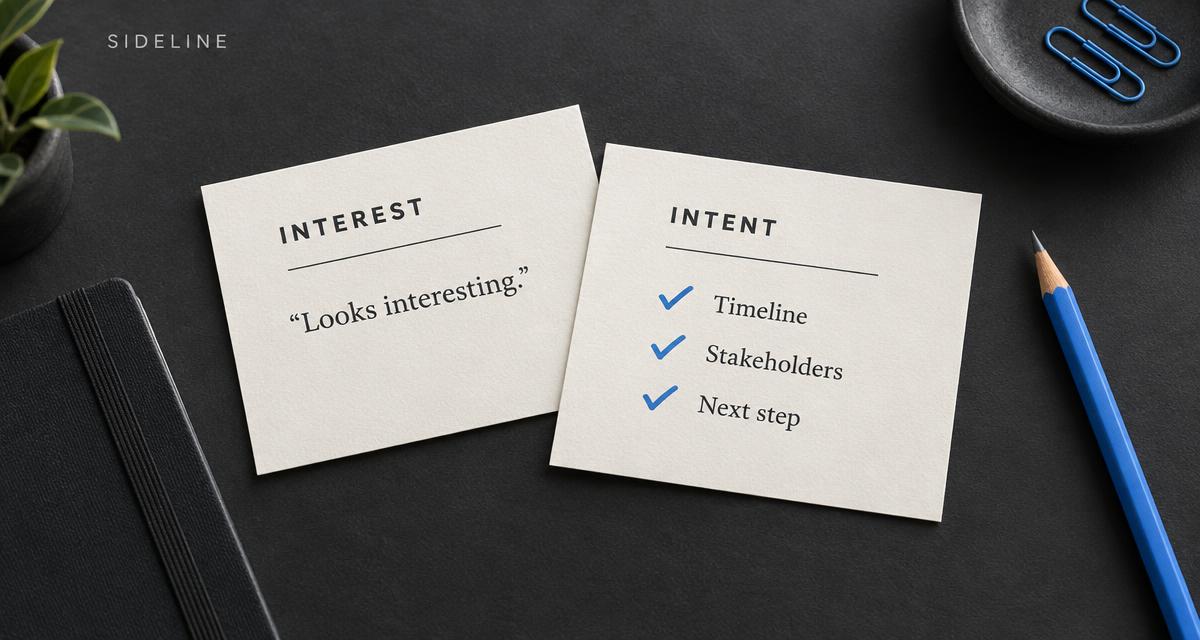
15 Sales Questions That Reveal Buying Intent (Not Just Interest)
15 practical B2B sales questions to uncover urgency, decision criteria, obstacles, and genuine buying intent beyond polite interest.

How to Run a B2B Discovery Call: A Practical Guide for Founders
A 30-minute agenda, 12 practical questions, and a better way to understand what your buyer really needs.

Real-Time AI Sales Coaching: How It Works and Why It Matters
How live AI coaching works during a sales call, how it compares to post-call analysis, and where it helps founders and reps most.