AI Sales Coaching
AI Sales Coach vs. AI Meeting Notetaker: What’s the Difference?
You just finished a discovery call.
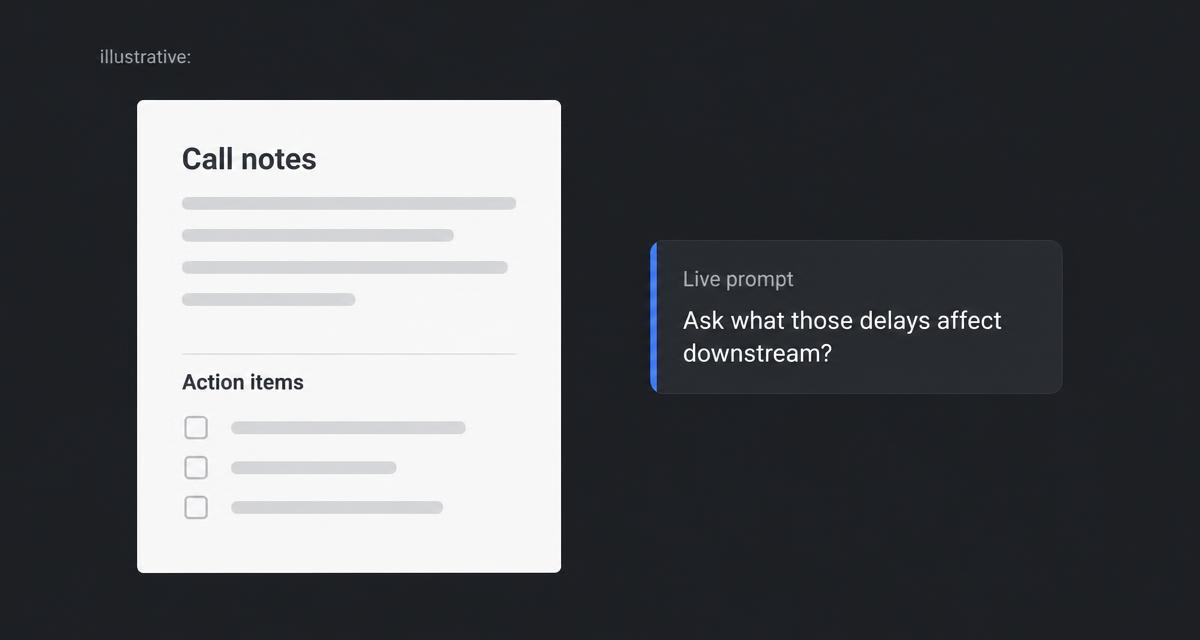
Your AI meeting notetaker captured the prospect's pain points, the questions they asked, and the follow-up you promised to send. The notes are organized. The action items are clear.
Then you read the summary and realize something else: you spent ten minutes demonstrating features before asking what the problem actually costs the buyer.
The notes tell you what happened. But you also want to know what you should have done differently.
That's the difference between the core jobs of an AI meeting notetaker and an AI sales coach. One emphasizes documentation and recall. The other emphasizes the skills and decisions that make sales conversations productive.
The categories increasingly overlap. Modern notetakers may provide pre-meeting briefs, ask-AI assistance during meetings, coaching feedback, and memory across conversations. Coaching platforms can also summarize calls and draft follow-ups. The question is which experience your workflow really needs.
What does an AI meeting notetaker do?
An AI meeting notetaker captures a conversation and turns it into useful records. Depending on the product, that may include transcription, summaries, decisions, action items, search, shared notes, and follow-up drafts.
For a founder moving between customer interviews, product meetings, and sales demos, those capabilities can save time and reduce the risk of forgetting commitments.
A good notetaker helps answer:
- What did the buyer say about implementation?
- Who promised to send the security document?
- What did we decide about timing?
- What came up in the last three meetings?
Some notetakers, including Granola, let you chat with meeting context live and across previous conversations. Others integrate information into CRMs or workspaces. So it would be inaccurate to say all notetakers only work after a meeting or have no memory.
What does an AI sales coach do?
An AI sales coach is designed to help a seller improve how they conduct sales conversations. That may involve live prompts, structured feedback, skill tracking, roleplay, objection analysis, or manager-facing coaching.
An individual-focused, real-time coach helps answer a different question: What might I ask right now to make this conversation more useful?
Imagine a prospect says, “Our team wastes a lot of time manually checking customer records.”
A notetaker can capture that statement.
A live coach might suggest: “Ask how many hours the team spends on this each week.”
That suggestion isn't automatically correct. The seller still needs judgment. But it is oriented toward what happens next, not only preserving what happened already.
AI sales coach vs. AI meeting notetaker: feature comparison
| Question | AI meeting notetaker | AI sales coach |
|---|---|---|
| Primary objective | Capture and organize the meeting | Improve sales conversations and selling habits |
| Transcription and summaries | Usually central | Often included, varies by product |
| Action items and follow-up drafts | Common | May be available |
| Live assistance | Some products offer on-demand help | Some products offer proactive sales-specific prompts |
| Coaching feedback | Available in some products | Usually central to the experience |
| Cross-meeting context | Available in some products | Useful for ongoing deal and coaching context |
| Audience | Anyone who attends meetings | Sellers, founders, reps, and sales leaders |
| Best evaluation test | Accuracy, retrieval, sharing, workflow | Relevance, timing, distraction, behavioral usefulness |
These describe common product emphases, not mutually exclusive capabilities. Test the actual feature and plan rather than relying on the category label.
For a practical example, see our Sideline vs. Granola comparison.
Three moments that show the difference
1. A prospect mentions a painful workflow
Prospect: “Our onboarding process keeps slipping.”
A meeting note should preserve the concern and its context. A coach might suggest: “Ask what those delays affect downstream.”
Both are helpful. The note protects recall; the prompt encourages deeper discovery.
2. A prospect raises a price objection
Prospect: “Your competitor is cheaper.”
A notetaker can record the objection and add it to a follow-up. A coach might encourage you to ask: “Which capabilities are you comparing?”
The question can help you distinguish a budget issue from a value or scope comparison. A live prompt won't automatically win the deal; it can help you avoid responding before understanding the objection.
3. A second meeting revisits an old concern
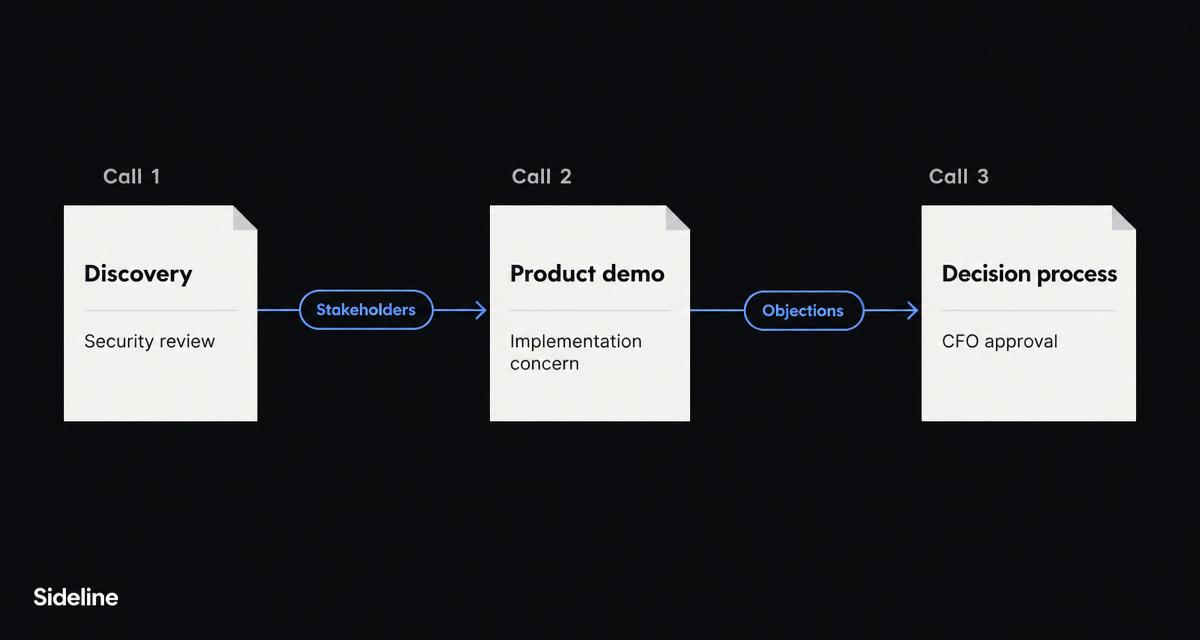
During the first call, the buyer mentioned an upcoming security review. During the second call, you discuss rollout timing.
A meeting assistant with good memory may summarize the open security requirement when asked, or put it in a pre-call brief. A context-aware sales coach might use that previous information to remind you to confirm the security review status during the call.
The important distinction isn't who can store the information. It's how and when that information reaches the seller.
Can a notetaker coach you during the call?
Sometimes, yes. Don't assume “AI notetaker” means no live intelligence.
For example, Granola publicly describes real-time chat where a meeting participant can ask what they missed or what question to ask next. It also supports meeting briefs, cross-meeting chat, and sales-specific follow-up workflows.
That is meaningful live assistance. It is different in emphasis from an application centered on automatically surfacing short, sales-specific suggestions during the conversation. But the workflows can overlap, and both should be tested on real calls.
Likewise, some sales coaching systems have extensive note-taking features. The distinction is about product design and fit, not a rigid technological boundary.
Which one should a founder use?
Start with the constraint you're actually trying to solve.
Choose a notetaker first when you frequently lose details, miss follow-up commitments, need searchable meeting history, or collaborate on notes across many kinds of meetings.
Evaluate a sales coach first when you know the sales process but repeatedly miss discovery questions, rush into demos, struggle with objections, or leave calls without specific next steps.
Consider both if the tools are permitted by your company, their workflows don't conflict, and each provides distinct value. Double-capturing sensitive conversations should be reviewed against privacy and consent requirements.
There isn't a universal winner. An excellent notetaker can be more useful than an unreliable coach; a good live coaching prompt can be more valuable in a pivotal sales moment than another immaculate summary.
Five questions to ask before you buy
- What specific mistake am I trying to avoid? Missing notes and missing questions are different problems.
- Do I need help during the call or after it? If you want in-call prompts, test the exact live feature.
- Does the system remember previous meetings? Check whether earlier context is actually available when needed.
- Will I keep listening to the buyer? A wall of suggestions can make you worse at the conversation.
- How does it handle privacy, consent and retention? Compare policies and configuration, not slogans.
Use an actual 30-minute discovery call as your test. Evaluate whether the output changes a specific behavior you care about, without claiming statistical results from one example.
Where Sideline fits
We're building Sideline as a Mac-first AI sales coach for founders and individual B2B sellers.
Its core experience is a small overlay that aims to provide one short, contextual prompt during live conversations. Afterward, Sideline provides a coaching debrief and can draft a follow-up. It maintains prospect and call history while we refine cross-call coaching and recurring-skill feedback in private beta.
Sideline isn't trying to be the best general-purpose notepad for every meeting. We're focused on helping the person selling recognize the next useful question, then learn from the conversation afterward.
Illustrative example
Prospect: “Our finance team will need to review this.”
Sideline-style prompt: “Ask what finance needs to approve the purchase.”
The goal isn't to replace judgment or automate a buyer relationship. It's to keep a relevant question from getting lost while you're handling everything else on the call.
For a deeper breakdown of the product experience, see AI sales coaching for founders and how cross-call memory works.
Frequently asked questions
Can AI notetakers suggest questions during a live call?
Some can. Certain tools provide live chat or meeting assistance and can answer a user’s question during a call. The level of proactive coaching varies by product.
Is an AI sales coach the same as conversation intelligence software?
Not necessarily. Conversation intelligence often emphasizes analyzing and organizing interactions for reps and managers. Sales coaching emphasizes helping sellers improve behaviors. Products may combine them.
Do I still need a CRM if I use either tool?
Usually yes, if your team uses a CRM for pipeline, contacts, and opportunity management. Notes and coaching don't automatically replace those processes.
Can I use an AI coach and a meeting notetaker together?
Potentially. Verify compatibility, corporate policies, consent, and how both handle audio and transcript data. There may be overlapping functionality.
Does Sideline automatically remember every meeting?
Sideline stores relevant prospect and call history. Applying history consistently during later live calls is an area of ongoing beta refinement; it should not be assumed to be perfect or universal.
Final thought
A meeting notetaker helps you remember the conversation. A sales coach tries to help you conduct it better. Good products increasingly blur the line.
The right choice is the one that solves your actual problem. If you know the detail but keep missing the moment, evaluate live coaching. If you ask great questions but lose the record, invest in better notes. And if both matter, design a workflow that helps you stay present with the person on the other end of the call.
Sideline · Private beta
A coach in your corner, while the prospect is still there.
Short, contextual prompts during your calls and a coaching debrief afterward.
Get Early Access
Real-Time AI Sales Coaching: How It Works and Why It Matters
How live AI coaching works during a sales call, how it compares to post-call analysis, and where it helps founders and reps most.
How AI Sales Coaching Remembers Previous Conversations (And Why It Matters)
How cross-call memory connects prospect history, unresolved objections, commitments, and seller habits before, during, and after B2B sales calls.

Best AI Sales Coaching Tools in 2026: 8 Options Compared for Founders & Sales Teams
Eight AI sales coaching tools compared — live coaching, call reviews, and practice — with a focus on founders, AEs, and growing B2B teams.